Not all activated carbon is the same because variations in manufacturing affect its pore structure, surface area, and granular makeup. More carbon doesn’t always mean better odor control; the key is the quality and type of granules. Fine granules absorb odors quickly but may saturate faster, while coarser ones last longer. Understanding these differences helps you choose the right carbon for your needs, and discovering more details can improve your odor management strategies.
Key Takeaways
- Different manufacturing methods produce activated carbon with varying pore structures and surface chemistries, affecting odor absorption.
- Coarser granules tend to last longer and are better suited for ongoing odor control, while finer granules absorb odors quickly but saturate faster.
- Higher surface area in activated carbon generally improves odor adsorption, but performance also depends on pore size distribution.
- Simply using more activated carbon doesn’t guarantee better odor removal; the granular makeup and quality are crucial.
- Understanding the manufacturing process helps select the most effective activated carbon for specific odor control needs.
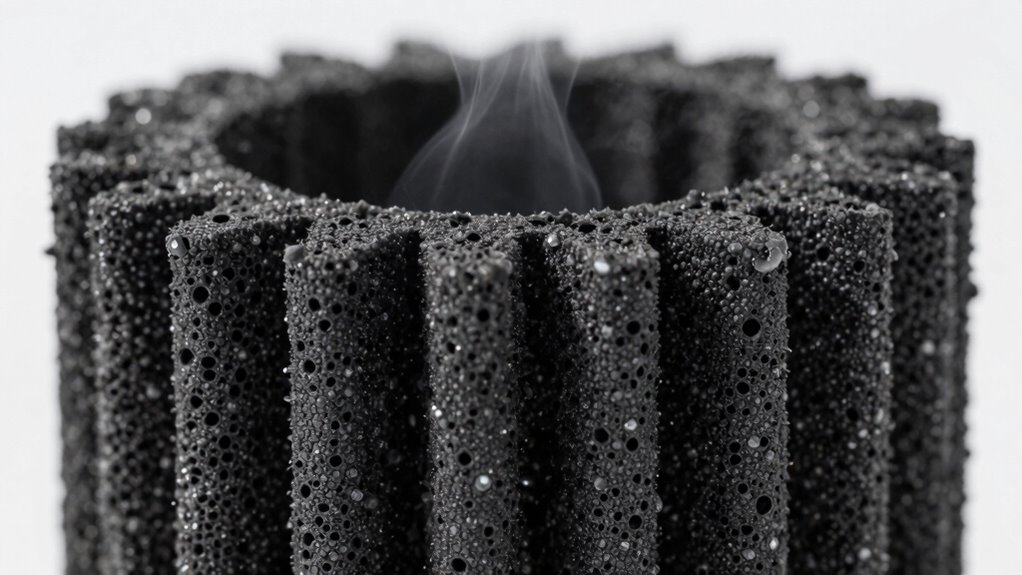
Activated carbon may seem uniform, but in reality, not all types are created equal. When you look closely, you’ll notice there are significant granular differences that influence how effectively it absorbs odors and impurities. These differences arise from manufacturing variations, which impact the pore structure, surface area, and overall performance of the carbon. Understanding these distinctions can help you choose the right product for your specific needs, especially when it comes to odor removal.
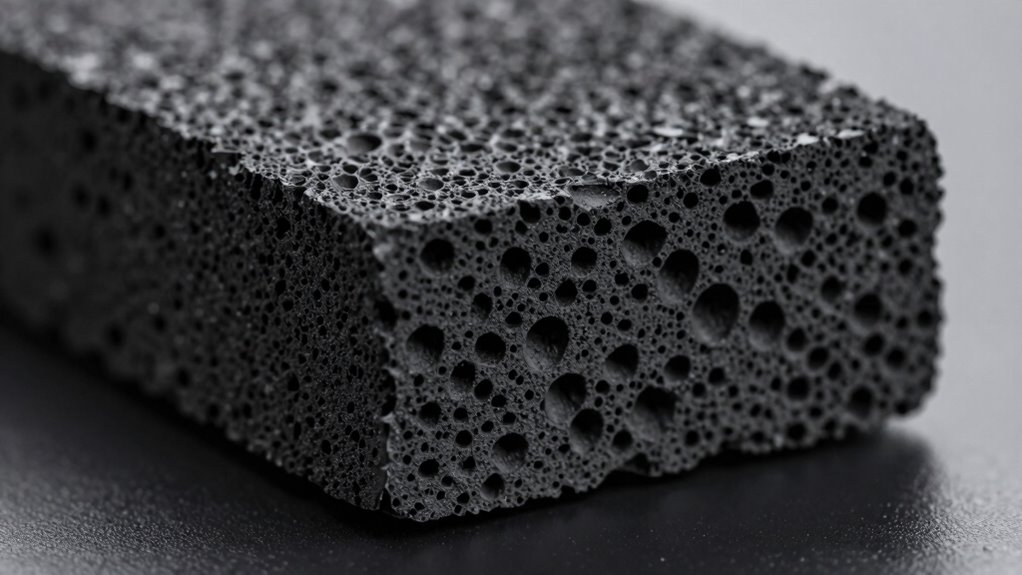
The granules or powders of activated carbon are not just uniform chunks; they are crafted with precision, yet subtle variations in manufacturing can lead to noticeable differences in performance. For example, some activated carbons are produced with a focus on creating a highly porous structure, maximizing surface area to trap molecules more efficiently. Others may have a coarser granulation, which can influence how quickly odors are adsorbed and how long the carbon remains effective. These granular differences are essential because they determine how well the carbon interacts with specific odors, especially in environments with complex or stubborn smells.
Manufacturing variations also affect the quality and consistency of activated carbon. Different production methods, such as steam activation or chemical activation, result in variations in pore size distribution and surface chemistry. Steam-activated carbons often have a more uniform pore structure, making them ideal for general odor control. Conversely, chemically activated carbons might offer a higher surface area but can vary more between batches, potentially leading to inconsistent odor absorption. When selecting activated carbon, you should pay attention to these manufacturing details because they directly influence how well the product performs in removing particular odors.
You might assume that more carbon always equals better odor control, but that’s not necessarily true. The effectiveness depends heavily on the granular makeup and manufacturing quality. For instance, a bag of finely ground activated carbon with a high surface area might absorb odors faster initially but could also become quickly saturated if the granules are too fine and prone to clogging. Conversely, coarser granules with slightly less surface area may last longer and be better suited for continuous odor management in larger spaces. Knowing these granular differences helps you match the right type of activated carbon to your environment, whether it’s for air purification, water treatment, or industrial use. Additionally, understanding manufacturing techniques can help you make more informed choices based on the specific properties needed for optimal odor removal.

VEVOR Air Scrubber with 3-Stage Filtration, Stackable Negative Air Machine 800 CFM, Air Cleaner with MERV10, Carbon, H13 HEPA, for Home, Industrial and Commercial Use
UV-C Light Technology: Our air scrubber has built-in UV-C light that eliminates airborne pollutants better than ordinary air...
As an affiliate, we earn on qualifying purchases.
Frequently Asked Questions
How Do Manufacturing Processes Affect Activated Carbon’s Odor Absorption?
Manufacturing processes greatly influence activated carbon‘s odor absorption by guaranteeing strict manufacturing standards and quality control. When you choose high-quality activated carbon, it’s produced with precise activation methods that create ideal pore structures for trapping odors. Consistent quality control minimizes impurities that could cause unwanted smells, so you get more effective odor absorption. In short, careful manufacturing ensures your activated carbon performs reliably, making it more efficient at neutralizing odors.
What Are the Differences Between Coconut Shell and Coal-Based Activated Carbon?
You might think all activated carbons are the same, but natural sources and manufacturing variations make a difference. Coconut shell carbon offers high porosity and fast odor absorption, ideal for air purification. Coal-based carbon tends to be more cost-effective and durable, suitable for water treatment. Your choice depends on your needs; understanding these differences helps you select the best activated carbon for your application.
Can Activated Carbon’s Effectiveness Decline Over Time?
Yes, activated carbon’s effectiveness can decline over time. As it absorbs odors, it reaches odor saturation, reducing its ability to trap new molecules. The carbon lifespan varies depending on usage, but once saturated, it needs replacement or reactivation. Regular monitoring ensures you maintain peak odor control, preventing reduced performance and lingering smells. Keep an eye on odor saturation levels to maximize your activated carbon’s lifespan and efficacy.
Are There Specific Odors That Activated Carbon Cannot Eliminate?
You should know that activated carbon struggles to eliminate certain odors, like persistent pet odors and strong chemical fumes. While it’s effective for many smells, it can’t completely absorb all chemical compounds or deeply embedded pet scents. For these stubborn odors, you might need specialized filters or additional air purifying methods. Relying solely on activated carbon might leave some odors lingering, especially with persistent or potent sources.
How Should Activated Carbon Be Stored to Maintain Its Efficacy?
A stitch in time saves nine, so store your activated carbon properly. Keep it in airtight containers away from humidity, heat, and direct sunlight to maintain its efficacy. Proper storage conditions extend its shelf life and ensure it continues to absorb odors effectively. Avoid exposing it to moisture or contaminants, which can clog its pores. By doing so, you preserve its odor-eliminating power and get the most out of your activated carbon.

VEVOR Air Scrubber with 3-Stage Filtration, Stackable Negative Air Machine 550 CFM, Air Cleaner with MERV10, Carbon, H13 HEPA, for Home, Industrial and Commercial Use
3-stage Filtration: This air scrubber features a three-stage filtration system consisting of a pre-filter (MERV-10), carbon filter, and...
As an affiliate, we earn on qualifying purchases.
Conclusion
So, next time you choose activated carbon, remember it’s not just about ‘more’—it’s about quality and type. While more carbon might seem better for odor control, the right kind can make all the difference. Don’t just compare sizes; consider the nuances that affect performance. In the end, understanding these differences helps you make smarter choices, turning a simple filter into a powerful tool. Sometimes, less is more, but only if it’s the right kind.

ALORAIR Air Scrubber | UV-C Light | Professional 3-Stage Filtration Negative Machine Air Purifier | HEPA Scrubber up to 750 CFM | Water Damage Restoration for Air Cleaner | PureAiro HEPA Pro 970
3-Stage Filtration System: AlorAir PureAiro HEPA Pro 970 Air Scrubber build with Variable Speed as a portable HEPA...
As an affiliate, we earn on qualifying purchases.

ALORAIR PureAiro HEPA Max 970 industrial Air Scrubber, 3-Stage Filtration System, GFCI Outlet, Negative Air Scrubber Water Damage Restoration Interior Decoration
3-Stage Filtration System: AlorAir PureAiro HEPA Max 970 Air Scrubber build with Variable Speed as a portable HEPA...
As an affiliate, we earn on qualifying purchases.