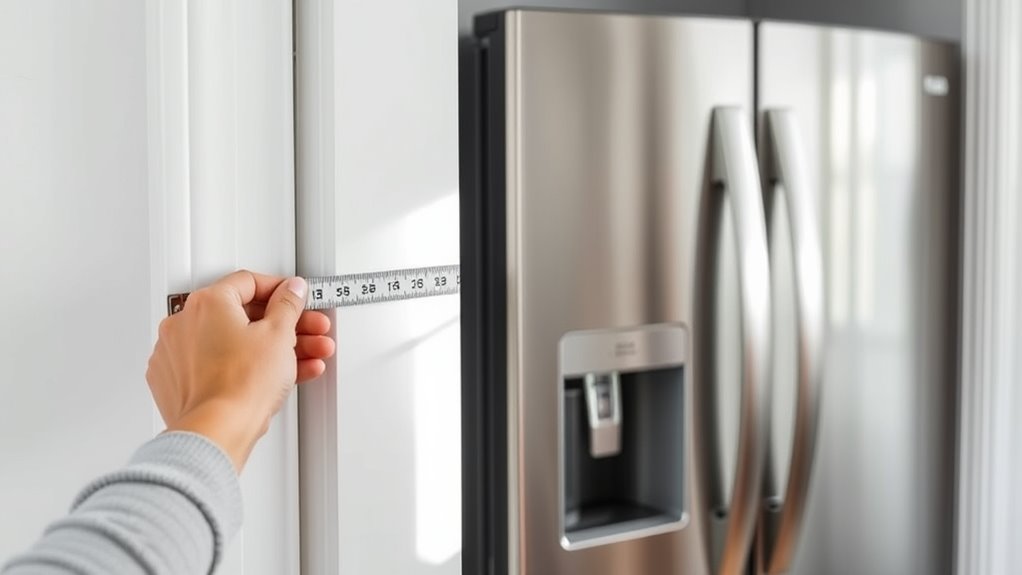

To guarantee your fridge fits through the doorway, start by measuring the width at its narrowest point inside the frame with a tape measure, and check the height, accounting for any obstructions like crown molding. Don’t forget to measure diagonally across the doorway to evaluate turning space. Add a few extra inches for clearance and maneuvering. Keep these measurements handy, and if you want to learn how to make all these calculations accurately, keep exploring the details below.
Key Takeaways
- Measure the doorway’s narrowest width at multiple points inside the frame with a tape measure.
- Check the doorway height, accounting for crown molding or obstructions, at several spots for accuracy.
- Include the fridge’s widest parts, like handles or hinges, and add extra clearance for maneuvering.
- Remove any obstacles, such as door stops or nearby furniture, to ensure clear passage and accurate measurements.
- Double-check all measurements and consider the fridge’s angle or tilt needed to pass through safely.

When you’re fitting a new fridge into your home, precisely measuring your doorways is essential to guarantee it will pass through without issues. Before you even start shopping for your new appliance, take the time to measure your doorway clearance carefully. Knowing the exact width and height of your doorways ensures you won’t face unexpected obstacles during appliance removal or delivery. Start by measuring the doorway’s width at its narrowest point—usually just inside the frame—using a tape measure. Don’t forget to check the height too, especially if you have crown molding or other obstructions that might interfere with the fridge’s passage. Record these measurements precisely, and always measure in multiple spots since door frames can sometimes be uneven.
Measuring doorways carefully ensures your new fridge fits without surprises during delivery.
Next, consider the space required for appliance removal. If your current fridge is bulky or has handles that extend beyond its main body, you’ll need to account for those when evaluating doorway clearance. Remove any obstructions around the doorway that could hinder the appliance’s movement, such as door stops or furniture, to get an unobstructed measurement. When measuring the fridge, include its widest points—usually the doors or handles—and add a few extra inches to accommodate maneuvering. This buffer helps prevent surprises during delivery, especially if the appliance is large or if tight corners are involved.
It’s also wise to think about the angle at which the fridge will need to pass through the doorway. Sometimes, rotating the appliance or tilting it slightly can make a difference. To determine if this is feasible, measure the diagonal space from one corner of the doorway to the opposite corner. This measurement can reveal whether turning the fridge at an angle might help it pass through more easily. Keep in mind, the actual size of the fridge, including its handles, hinges, or protrusions, must be less than the doorway clearance plus any extra space you’ve allotted for safe maneuvering. Additionally, understanding the best modern toilet options can be useful if planning a full bathroom renovation to complement your appliance updates.
Finally, double-check all your measurements before scheduling delivery. If your doorway measurements are tight or borderline, consider removing the door from its hinges temporarily to increase clearance. In some cases, removing nearby furniture or fixtures can make a significant difference. Remember, accurate measurements are your best defense against surprises during appliance removal or delivery. Taking the time to measure properly ensures your new fridge will fit smoothly, saving you time, effort, and potential damage to your home or appliance.
Frequently Asked Questions
Can Door Hinges Affect Fridge Clearance Measurements?
Hinge clearance and hinge positioning can definitely impact your fridge’s fit. If the hinges are bulky or positioned differently, they might reduce the space needed for the door to open fully. When measuring, account for hinge clearance by including the hinges’ size and placement. Properly measuring hinge positioning guarantees you don’t underestimate the doorway size needed, helping your new fridge fit smoothly without scraping or difficulty opening.
Should I Include Door Handles in Width Measurements?
When measuring for your fridge, you should include door handles in your width measurement to guarantee it fits through the doorway comfortably. Door handle inclusion is essential for measurement consistency because handles protrude and can affect clearance. Be sure to measure from the outermost points of the handles, not just the fridge body, so you avoid surprises when moving your new appliance into place.
How Do I Measure for Angled or Non-Standard Doorways?
When measuring for angled or non-standard doorways, you need to carefully evaluate the doorway width and any irregular angles. Use measurement tools like a tape measure to determine the exact width at different points, especially if the doorway isn’t perfectly square. Measure from corner to corner along the angle, noting the widest points. Record these measurements accurately, so you can compare them to your fridge’s dimensions and ensure a proper fit.
What’s the Best Way to Verify Measurements Before Purchasing?
Think of verifying measurements as preparing a treasure map before a hunt. You need reliable clues—appliance dimensions and measurement tools—to avoid surprises. Measure doorways, including height, width, and any angles, carefully and twice. Use a tape measure for accuracy. Verify the fridge’s dimensions match your doorway measurements, accounting for clearance. This ensures your new appliance will fit smoothly, saving you time and potential hassle.
Do I Need to Measure for Clearance When Doors Are Open?
When considering door swing and hinge clearance, you should definitely measure for clearance when doors are open. This guarantees your fridge won’t hit walls or furniture once the door swings open. Check the space needed for the door to open fully without obstruction. By doing this, you avoid surprises and make sure your new fridge fits perfectly, even when the door is open.
Conclusion
Now that you’ve measured your doorways carefully, imagine wheeling your new fridge right in—clear, smooth, and hassle-free. But what if those measurements just fall short? Will you need to remove a door or call for help? The key is in your hands now. Double-check your numbers, visualize that perfect fit, and get ready to see your kitchen transform. The exciting part? The fridge’s new home is just one precise measurement away.