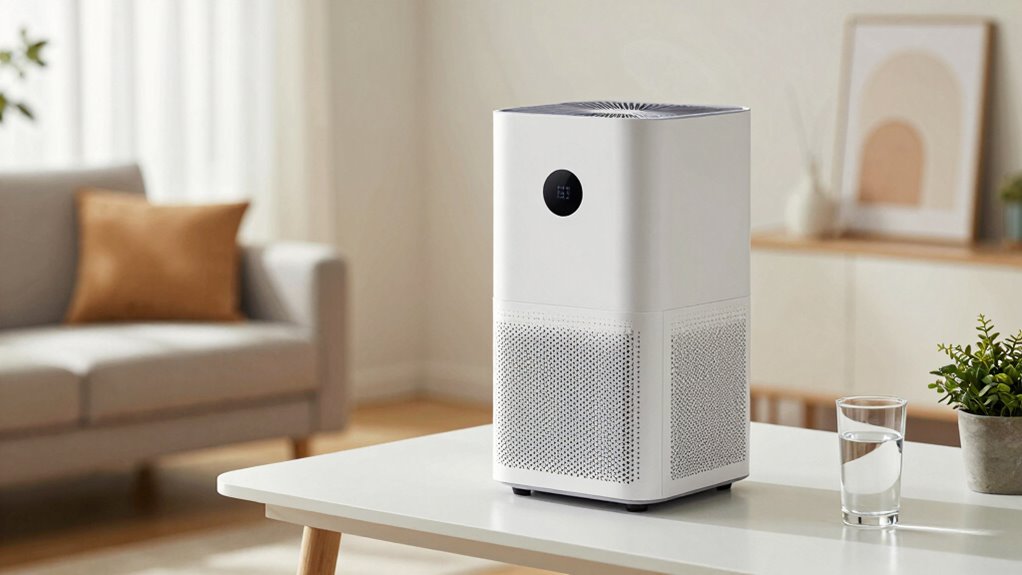
CADR, or Clean Air Delivery Rate, is the key number to understand when choosing an air purifier because it shows how effectively the device cleans your indoor air. It measures how quickly and efficiently it removes smoke, dust, and pollen. A higher CADR means better air cleaning. This number lets you compare products easily and avoid marketing hype. To learn what else makes a good air purifier, keep exploring how CADR impacts your air quality.
Key Takeaways
- CADR stands for Clean Air Delivery Rate, measuring how effectively an air purifier cleans specific pollutants like smoke, dust, and pollen.
- It provides a straightforward way to compare different air purifiers’ performance based on standardized testing.
- Higher CADR ratings indicate faster and more efficient removal of airborne contaminants.
- CADR ratings are set by organizations like AHAM to ensure consistent testing and reliable product comparisons.
- Using CADR helps consumers choose air purifiers that genuinely improve indoor air quality, avoiding marketing hype.

Have you ever wondered how to measure an air purifier’s effectiveness? It’s a fair question, especially when so many models claim to clean your air better than others. The key number you need to understand is CADR, which stands for Clean Air Delivery Rate. This figure is designed to give you a clear, easy way to compare different air purifiers. But to truly grasp what CADR means, it helps to understand air purifier standards and the CADR testing methods used to determine these ratings. These standards ensure that the numbers are consistent and reliable, so you’re not just relying on marketing hype.
Understanding CADR and testing standards helps you choose effective air purifiers confidently.
Air purifier standards are set by organizations like the Association of Home Appliance Manufacturers (AHAM). They create uniform testing protocols to make sure every product is evaluated under the same conditions. This consistency is vital because it means that a CADR rating from one purifier can be fairly compared to another. When a manufacturer submits their product for testing, they follow specific CADR testing methods that simulate real-world conditions, such as how well the device filters out smoke, dust, and pollen. These tests measure how quickly and efficiently an air purifier can clean the air in a controlled environment, providing a number that reflects its performance in real life.
Understanding these standards and testing methods helps you cut through the marketing noise and focus on what really matters. When you see a CADR rating, remember it’s not just a random number. It’s the result of rigorous testing designed to reflect how well the purifier performs in your home. For example, a higher CADR for smoke indicates the purifier can remove airborne smoke particles faster, which is especially important if you or someone in your household suffers from allergies or asthma. Similarly, CADR ratings for dust and pollen tell you how effective the device will be at clearing common indoor allergens.
Knowing about air purifier standards and CADR testing methods empowers you to make smarter choices. Instead of getting caught up in flashy claims, you can focus on the ratings that matter. Look for products that have been tested according to recognized standards, and compare their CADR ratings across the categories that matter most to you. This way, you’ll choose an air purifier that genuinely improves your indoor air quality, providing the clean air you deserve. Remember, that single number—the CADR—is the most straightforward way to understand how well an air purifier works, so always give it the attention it deserves when shopping. Additionally, understanding the vetted standards ensures that you’re relying on consistent and trustworthy testing results.
Frequently Asked Questions
How Is CADR Measured in Different Air Purifiers?
You measure CADR in different air purifiers by evaluating airflow dynamics and filter efficiency. Higher airflow means more air passes through the filters per minute, while better filter efficiency captures more particles. Testing involves running the purifier in controlled conditions with specific particle types, then measuring how many particles are removed from the air each minute. This combined approach ensures CADR accurately reflects how well the purifier improves indoor air quality.
Does Higher CADR Always Mean Better Air Purification?
Does a higher CADR always mean better air purification? Not necessarily. While higher CADR scores indicate faster removal of particles, air purifier ratings must also meet established air quality standards and suit your room size. You should consider factors like filter quality and device maintenance too. So, focus on overall performance rather than just the CADR number to guarantee your air stays clean and healthy.
Can CADR Be Used to Compare Different Brands Effectively?
Yes, you can use CADR for air purifier comparison, but remember its limitations. It helps you see which device filters air faster, but it doesn’t account for factors like room size, noise, or filter quality. Don’t rely solely on CADR when choosing an air purifier; consider other features too. Comparing brands with CADR gives you a good starting point, but always check reviews and specifications for a complete picture.
How Does Room Size Affect the Importance of CADR?
Room size directly affects how important CADR is for your air quality. If your space is large, you need an air purifier with a higher CADR to effectively clean the air. Conversely, smaller rooms require lower CADR ratings. Always match your purifier’s CADR to your room size to guarantee ideal air quality. Ignoring this can lead to less effective purification, leaving your air less clean than it could be.
Are There Any Limitations to Relying Solely on CADR?
Think of relying solely on CADR as counting stars to understand the night sky; it’s helpful but doesn’t reveal everything. While CADR measures air purifier efficiency, it ignores factors like noise level considerations and filter lifespan. You might find an air purifier with a high CADR that’s too noisy or has short-lived filters, so don’t overlook these details. Balance CADR with noise and maintenance to truly breathe easier.
Conclusion
Now that you understand CADR, remember it’s the key number to select a safe, effective air purifier. Did you know that a CADR of 300 or higher can clean a typical room in just 15 minutes? That means faster, cleaner air for you and your loved ones. Keep this number in mind when shopping—it’s the best way to guarantee you’re investing in an air purifier that truly makes a difference. Your health depends on it!