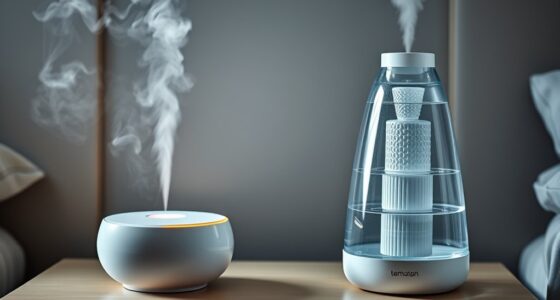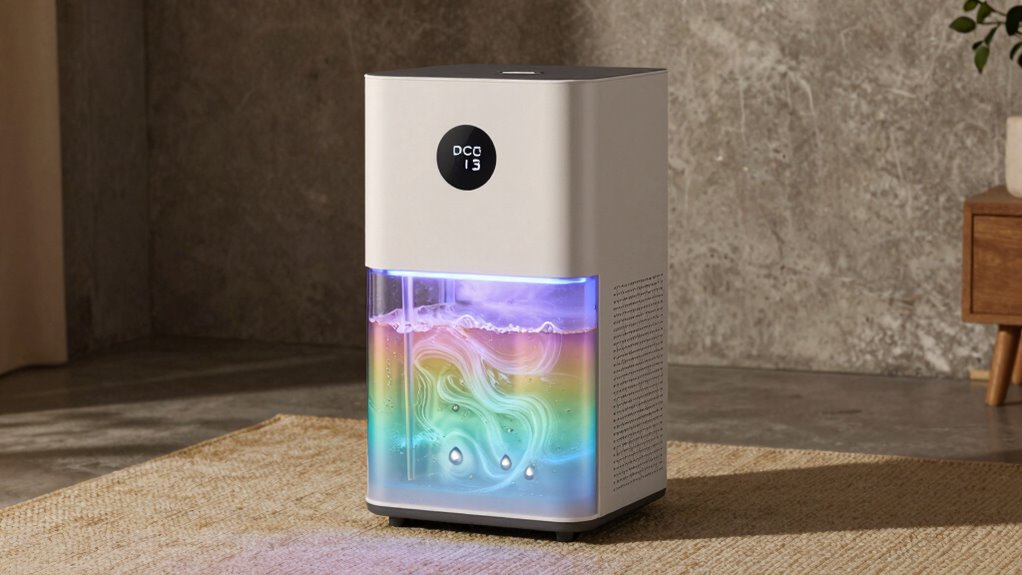
When choosing a dehumidifier, don’t rely solely on its pints-per-day rating. While it helps estimate capacity, your room’s size, insulation, moisture sources like bathrooms, and airflow also influence the right size. An undersized unit won’t control humidity effectively, and an oversized one wastes energy. To guarantee ideal performance and efficiency, consider all these factors—if you keep exploring, you’ll discover how to select the perfect fit for your space.
Key Takeaways
- Capacity in pints/day doesn’t consider room size, insulation, or moisture sources affecting actual dehumidification needs.
- Proper sizing depends on factors like room square footage, humidity levels, and ventilation, not just pint capacity.
- Oversized or undersized units can waste energy or fail to control humidity effectively, highlighting the importance of comprehensive assessment.
- Energy efficiency improves when the dehumidifier is correctly matched to space conditions, avoiding frequent cycling or constant running.
- Use sizing charts or professional guidance to account for all factors beyond capacity ratings for optimal moisture control.
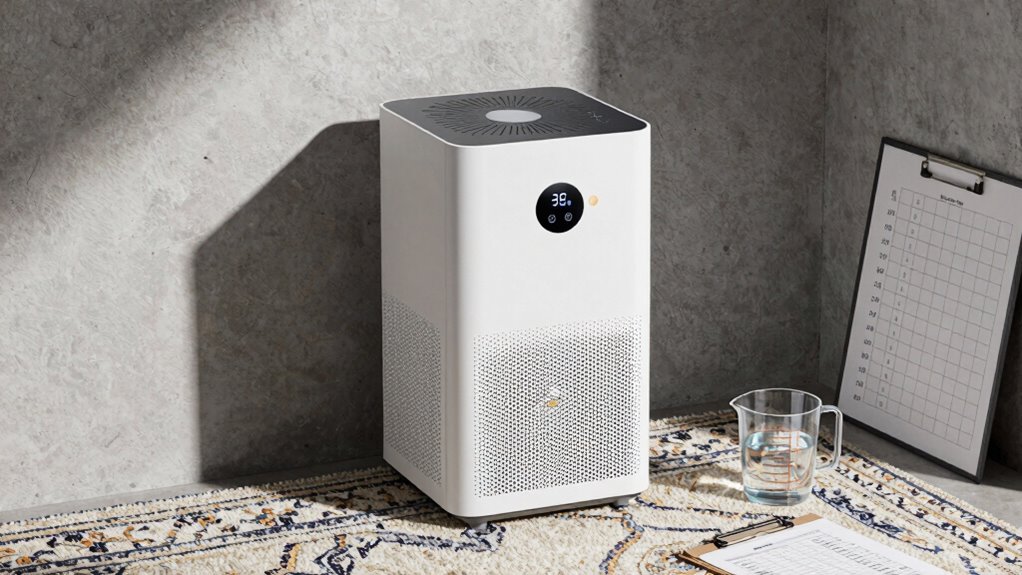
Choosing the right dehumidifier size is essential to effectively control moisture levels in your space. When you pick a unit that’s too small, it won’t remove enough humidity, leading to persistent dampness and potential mold growth. On the other hand, selecting a larger-than-needed dehumidifier can waste energy and drive up your electricity bills. To optimize both moisture control and energy efficiency, you need to consider more than just the pint-per-day capacity.
Choosing the right dehumidifier size balances moisture control and energy efficiency for your space.
While the dehumidifier’s rated capacity in pints per day gives you a starting point, it doesn’t tell the full story. Factors like room size, insulation, and existing moisture sources play a crucial role in determining the ideal size for your needs. For example, a small basement with high humidity due to poor insulation may require a different unit than a large, well-ventilated living room. Simply relying on the pint capacity can lead you to oversize or undersize your unit, which impacts performance and energy use.
Energy efficiency becomes a key concern when sizing your dehumidifier. An appropriately sized unit operates more efficiently because it doesn’t run excessively or struggle to keep up, saving you money in the long run. If your dehumidifier is too powerful for the space, it will cycle off frequently, wasting energy and reducing its lifespan. Conversely, a unit that’s too small will run constantly without effectively reducing moisture, which can also lead to higher energy consumption. Therefore, understanding the specific conditions of your space helps you select a model that balances moisture control with energy efficiency.
Additionally, space conditions such as ventilation and airflow can influence how well a dehumidifier performs, making it important to consider these factors during selection. To choose correctly, consider the room’s square footage, the typical humidity level, and any sources of excess moisture like bathrooms or laundry areas. Use these details to consult sizing charts or speak with a professional. They can help you identify a unit that’s just right—big enough to handle your moisture load but not so large that it wastes energy. Keep in mind, many modern dehumidifiers come with adjustable settings and humidity sensors that help them operate efficiently once set up properly.
Frequently Asked Questions
How Does Room Insulation Affect Dehumidifier Efficiency?
Room insulation impact considerably affects dehumidifier efficiency. When your space has good insulation, thermal barriers help maintain consistent humidity levels, making your dehumidifier work less hard. Poor insulation allows moisture to seep in or escape, forcing the unit to run longer. Proper insulation minimizes this impact, ensuring your dehumidifier operates efficiently, saves energy, and effectively controls humidity without overworking.
Can a Dehumidifier Be Too Large for a Space?
Yes, a dehumidifier can be too large for your space, causing excessive noise and higher energy consumption. When you choose a unit that’s too powerful, it cycles off frequently, which can increase noise levels and waste energy. This not only makes it less efficient but also more disruptive. To avoid this, select a dehumidifier properly sized for your room’s size and moisture levels, ensuring quieter operation and ideal energy use.
What Maintenance Is Required for Optimal Dehumidifier Performance?
To keep your dehumidifier performing well, you should regularly replace the filter and clean the coils. Check the filter every month and replace it if it’s dirty or clogged to guarantee proper airflow. Additionally, clean the coils periodically to prevent dust buildup, which can reduce efficiency. By maintaining these components, you’ll extend your dehumidifier’s lifespan and keep your space comfortably dry.
How Do Humidity Levels Influence Dehumidifier Capacity Selection?
Humidity levels directly impact your dehumidifier capacity choice. If the moisture levels are high, you’ll need a unit with greater capacity to effectively control humidity and prevent excess moisture buildup. Conversely, in areas with lower humidity, a smaller capacity dehumidifier suffices. To achieve peak humidity control, assess your space’s moisture levels carefully, ensuring you select a dehumidifier that can handle the specific humidity conditions for consistent, reliable performance.
Are Portable Dehumidifiers Suitable for Large-Scale Applications?
Like David facing Goliath, portable dehumidifiers aren’t ideal for large-scale use. They’re designed for small spaces and limited capacity, making them inefficient and impractical for extensive areas. If you need to manage humidity across a large environment, you’ll want dedicated, industrial-grade units. Portable units excel in small rooms or localized spots but fall short when tackling big jobs, where bigger, more powerful systems are your best bet.
Conclusion
So, next time you pick a dehumidifier, don’t just blindly trust the pints per day. Imagine cramming a tiny, squeaky mouse into a mansion—sure, it might sip water all day, but it’s not gonna keep the place dry. Instead, pick a unit that’s the right size, or you’ll end up with a soggy mansion full of mold and regret. Size really does matter—trust me, your walls will thank you.