Your smart vacuum uses advanced AI, sensors, and cameras to create detailed digital maps of your home. It processes environmental data in real-time to detect obstacles, furniture, and stairs, allowing it to navigate efficiently. These maps help optimize cleaning routes, reduce missed spots, and adapt to changes in your layout. As your vacuum learns over time, it keeps improving. Discover how this clever technology works behind the scenes to make your home cleaner and smarter.
Key Takeaways
- Robotic vacuum cleaners use sensors and cameras to create detailed digital maps of your home environment.
- Mapping algorithms process sensor data to recognize walls, furniture, and obstacles, enabling efficient navigation.
- Data is securely stored and encrypted to protect your privacy while allowing continuous learning and updates.
- The vacuum dynamically updates its map in real-time, adapting routes to changes like moved furniture or new obstacles.
- Advanced AI and home integration optimize cleaning paths, zones, and energy use for a smarter, more personalized home cleaning experience.
The Technology Behind Smart Vacuum Navigation
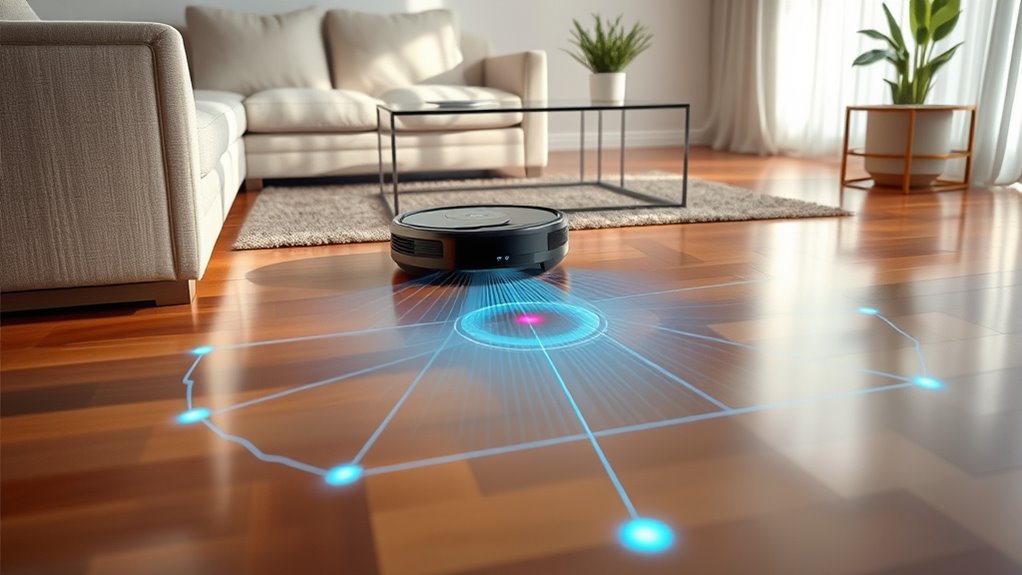
Smart vacuum cleaners rely on advanced navigation technology to efficiently clean your home. They use robotic algorithms that process data from sensors to understand their environment. These algorithms enable the vacuum to detect obstacles, avoid stairs, and navigate around furniture without user intervention. The key to their effectiveness is mapping accuracy; the more precise the map, the better the vacuum can plan its cleaning path. High mapping accuracy ensures thorough coverage, reduces missed spots, and prevents unnecessary repetitions. Many models utilize lidar, cameras, or infrared sensors to continually update their surroundings. Mapping precision is vital for optimal performance. This combination of robotic algorithms and precise mapping allows your smart vacuum to work intelligently, giving you a cleaner home with less effort on your part.
How AI Creates a Digital Map of Your Home
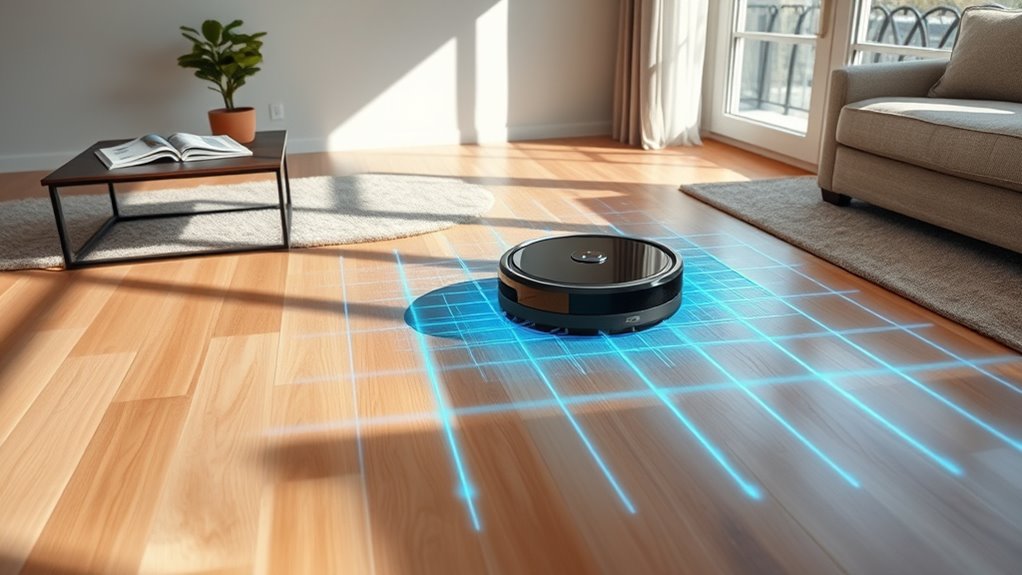
Your smart devices use sensors to gather data about your home’s layout and environment. This information is processed by mapping algorithms that create a detailed digital layout. However, it’s important to contemplate how your data is protected and what privacy measures are are in place.
Sensors and Data Collection
As AI-powered sensors placed throughout your home collect data, they continuously create a detailed digital map of your environment. To guarantee accuracy, these sensors require regular calibration, adjusting their sensitivity to capture precise measurements. Once data is collected, it’s protected through data encryption, safeguarding your privacy from unauthorized access. The sensors detect obstacles, room dimensions, and furniture placement, transmitting this information securely to the AI system. This constant data flow allows your smart device to build and update a comprehensive digital layout of your home in real-time. Ongoing automation advancements ensure your home adapts seamlessly to your needs, enhancing convenience and security. By maintaining proper sensor calibration and encrypting data, your home’s AI system stays reliable and secure, making your smart home experience seamless and trustworthy.
Mapping Algorithms at Work
Mapping algorithms process the data collected by sensors to create a detailed digital layout of your home. As your vacuum moves around, it gathers information about walls, furniture, and obstacles. Using robot learning, the AI continuously refines its understanding of your space, improving mapping precision with each pass. These algorithms analyze sensor inputs in real-time, adjusting the digital map to account for changes or new objects. The process ensures the map accurately reflects your home’s layout, allowing the vacuum to navigate efficiently. Advanced mapping algorithms can distinguish between different areas, optimize cleaning paths, and avoid obstacles. This seamless integration of robot learning and sensor data enables your vacuum to develop an increasingly precise map, making smart navigation possible and ensuring thorough cleaning without human intervention. Additionally, incorporating mapping algorithms similar to those used in complex systems like yoga pose recognition can enhance the vacuum’s ability to adapt to dynamic environments.
Privacy and Data Security
While AI-powered home mapping offers remarkable convenience, it also raises important privacy and data security concerns. Your digital maps contain detailed layouts of your home, making user privacy a top priority. If not protected, this data could be vulnerable to breaches or misuse. To safeguard your information, companies often use data encryption, ensuring that your home details stay secure during transmission and storage. Additionally, understanding cookie management can help users control how their data is collected and shared across different platforms.
Sensors and Cameras: The Eyes of Your Robot Vacuum
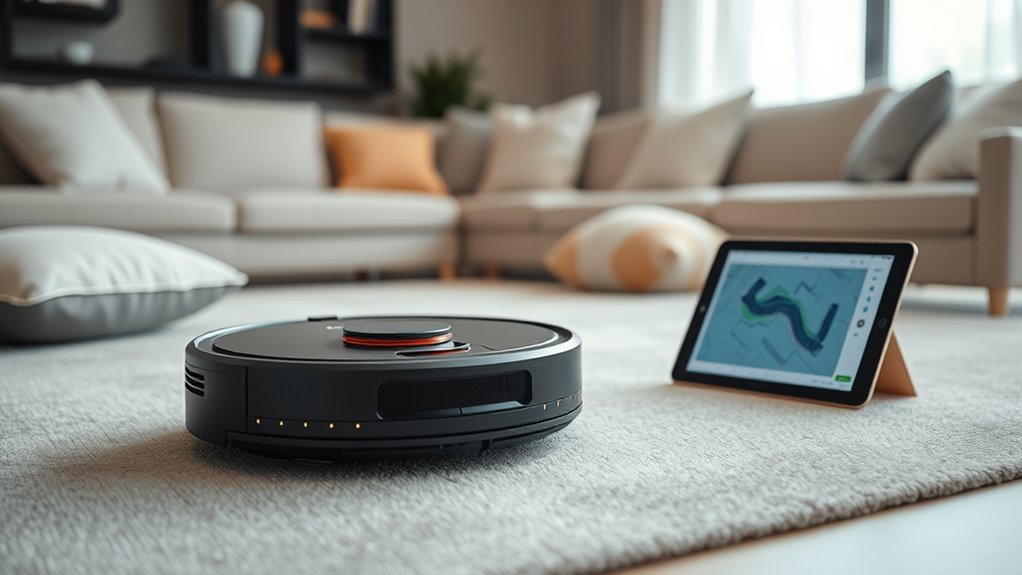
Your robot vacuum relies on sensors and cameras to see and navigate your home effectively. These tools help it recognize obstacles and avoid collisions in real time. With advanced visual navigation and obstacle detection techniques, it keeps your floors clean without getting stuck. Additionally, some models utilize AI-driven diagnostics to optimize performance and adapt to changing environments.
Visual Navigation Capabilities
Sensors and cameras serve as the eyes of your robot vacuum, enabling it to see and interpret its environment in real-time. This visual input markedly improves mapping accuracy, allowing your vacuum to create detailed maps of your home. By analyzing images and data, it can better understand room layouts and identify key features. These visual navigation capabilities also support advanced navigation strategies, helping your vacuum choose efficient cleaning paths. Cameras work alongside other sensors to provide a thorough view, ensuring thorough coverage. This combination reduces missed spots and prevents unnecessary re-tracing. Overall, visual navigation enhances your vacuum’s ability to adapt to different layouts, making cleaning more efficient and reliable without the need for constant manual oversight. Incorporating hybrid technology can further improve the effectiveness of these systems by combining multiple sensing methods for optimal performance.
Obstacle Detection Techniques
Visual navigation relies heavily on cameras and sensors to interpret your robot vacuum’s environment, but detecting obstacles accurately is equally important for safe and efficient cleaning. Obstacle identification involves sensors like infrared, ultrasonic, and lidar, which help your vacuum detect objects and avoid hazards. These sensors work together to create a real-time map of your space, allowing the robot to distinguish between furniture, walls, and potential obstacles like cords or pet toys. Cameras also assist in hazard avoidance by providing visual confirmation of objects. Combining sensor data with camera inputs ensures your vacuum moves smoothly around obstacles, preventing collisions and damage. This advanced obstacle detection technique makes your robot smarter, more reliable, and capable of cleaning thoroughly without getting stuck or causing accidents.
The Process of Learning Your Home’s Layout
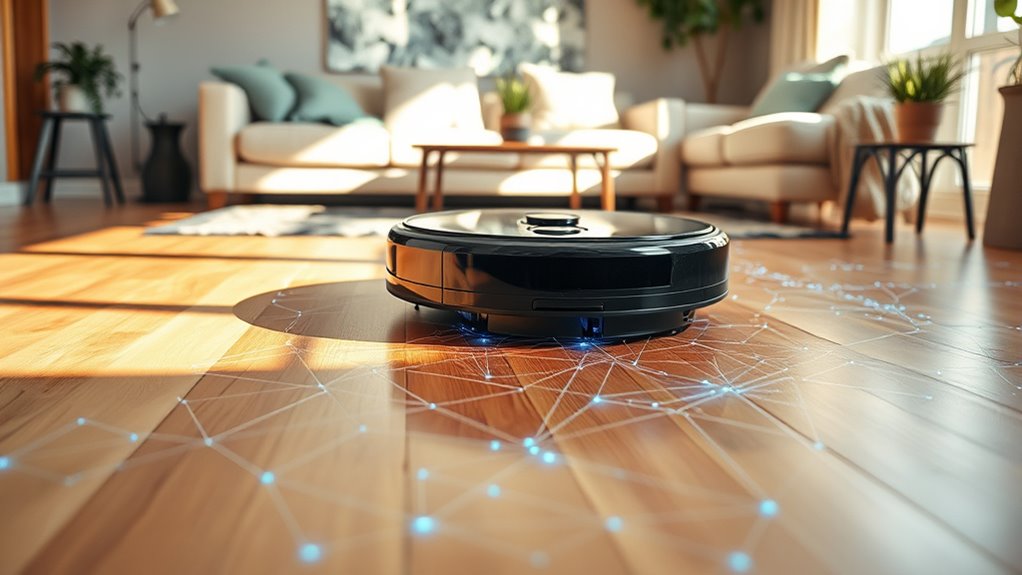
As your smart home begins to adapt, it actively maps out the layout by analyzing movement patterns and environmental data. Your vacuum uses sensors and cameras to gather information about each room’s size, shape, and obstacles. This process is essential for home automation, allowing the device to understand your space without manual input. It creates a digital map that details walls, furniture, and open areas. The more it learns, the better it becomes at planning effective cleaning routines. This mapping process enhances cleaning efficiency by reducing missed spots and avoiding obstacles. Over time, your vacuum refines its understanding, ensuring each cleaning session is faster and more thorough. Utilizing mapping technology enables the device to optimize its routes and adapt to changes in your home layout. Ultimately, this learning process helps your home stay smarter, cleaner, and more organized without you having to lift a finger.
Route Optimization for Efficient Cleaning

Once your smart home’s mapping is complete, route optimization kicks in to maximize cleaning efficiency. Your vacuum plans the most effective path, reducing unnecessary overlaps and saving battery life. It considers user customization, like preferred cleaning zones or avoid areas, to tailor the process to your needs. This targeted approach ensures your floors get thorough coverage without wasting power. The system dynamically adjusts routes if obstacles are detected or if battery levels drop, prioritizing essential areas first. Here’s a quick look at how route optimization works: enhances cleaning performance
| Step | Focus | Benefit |
|---|---|---|
| Mapping | Layout & zones | Accurate navigation |
| Path Planning | Efficient route selection | Battery conservation |
| Real-time Adjustment | Dynamic obstacle avoidance | Continuous cleaning efficiency |
This process keeps your home spotless while extending your vacuum’s battery life.
Memory and Obstacle Recognition Capabilities
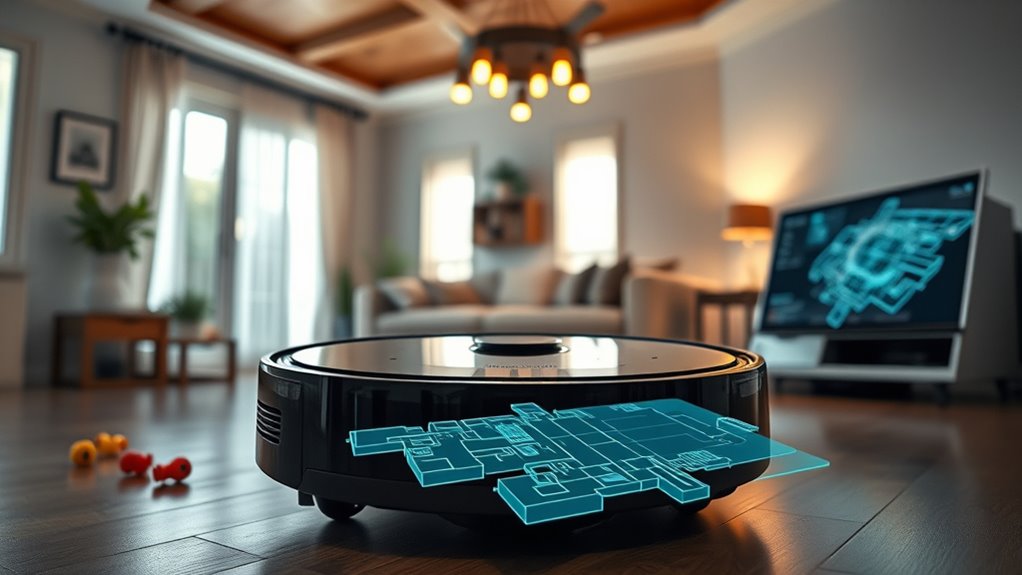
Your smart home’s vacuum relies on advanced memory and obstacle recognition capabilities to navigate effectively. Through robot learning, it continuously improves its understanding of your space, remembering obstacles and layout details. Memory retention allows the vacuum to recognize furniture, cords, or even toys, preventing repeated collisions. When it encounters an obstacle, sensors quickly identify and relay this information to its processing system, enabling real-time adjustments. Over time, the vacuum builds a detailed mental map, enhancing navigation efficiency. This combination of memory and obstacle recognition means fewer missed spots and fewer crashes, making your cleaning smarter and more reliable. By effectively learning from its environment, your vacuum becomes better at maintaining your home’s cleanliness with minimal intervention. Additionally, as part of its learning process, it utilizes sensor data to improve its obstacle detection and mapping accuracy.
Data Storage and Transmission of Home Maps
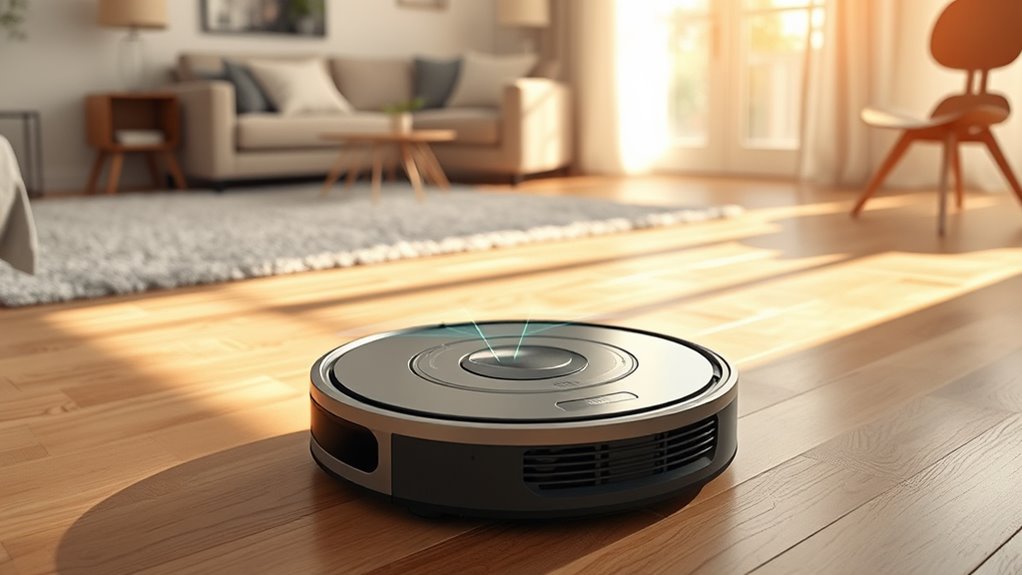
The memory and obstacle recognition capabilities of your smart vacuum rely on efficiently storing and transmitting detailed home maps. These maps are typically saved through data encryption to prevent unauthorized access, ensuring your home’s layout stays secure. When your vacuum updates or shares maps, it often uses cloud synchronization, sending data to remote servers for processing or backup. This process allows your device to access the latest maps and improve navigation over time. By encrypting data during transmission, your smart vacuum protects your information from potential breaches. Cloud synchronization also enables seamless updates across multiple devices, maintaining consistent mapping data. Additionally, integrating secure data storage practices ensures your privacy remains protected while benefiting from enhanced device performance. Overall, secure data storage and transmission keep your home maps accessible and protected, supporting the smart vacuum’s ability to navigate efficiently without compromising your privacy.
Privacy Concerns and Data Security
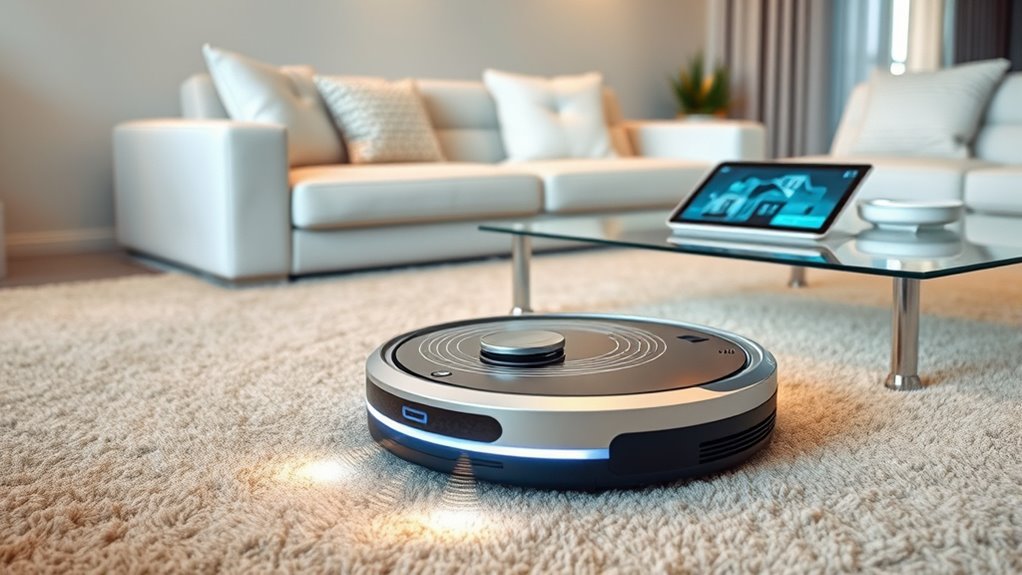
As smart home devices become more integrated into daily life, concerns about privacy and data security grow louder. Your vacuum’s mapping features often store detailed house layouts and user preferences, raising questions about who accesses this data. When you use voice commands to control your devices, sensitive information may be transmitted or stored remotely. If not properly protected, this data could be vulnerable to hacking or unauthorized sharing. Companies might also use your user preferences to personalize ads or improve services, but it’s important to understand how this information is handled. Always review privacy policies and security settings. Being aware of what data is collected and how it’s secured helps you protect your home’s privacy while enjoying the convenience of smart technology.
Impact on Smart Home Integration
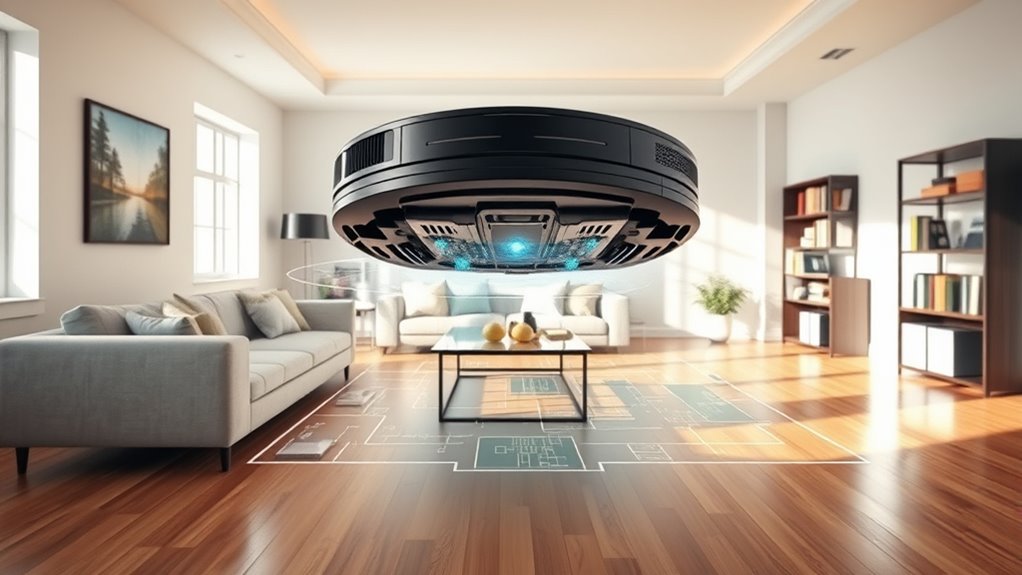
Smart home integration has been transformed by advances in AI, making devices work together more seamlessly than ever before. Your smart vacuum’s mapping capabilities enhance this by enabling better coordination with other devices. Here’s how it impacts you:
AI-powered smart home integration improves device coordination and efficiency for a more seamless, energy-saving experience.
- Voice control becomes more intuitive, allowing you to command multiple devices simultaneously.
- Your vacuum’s detailed maps help optimize cleaning routes, reducing energy use.
- Integration with smart thermostats ensures heating or cooling adjusts based on room occupancy.
- Lighting systems can respond to movement detected by the vacuum, improving efficiency and convenience.
These improvements mean your home operates more smoothly, saving energy and giving you easier control through voice commands. As AI continues to evolve, your smart home becomes smarter and more efficient.
Future Developments in Home Mapping Technology
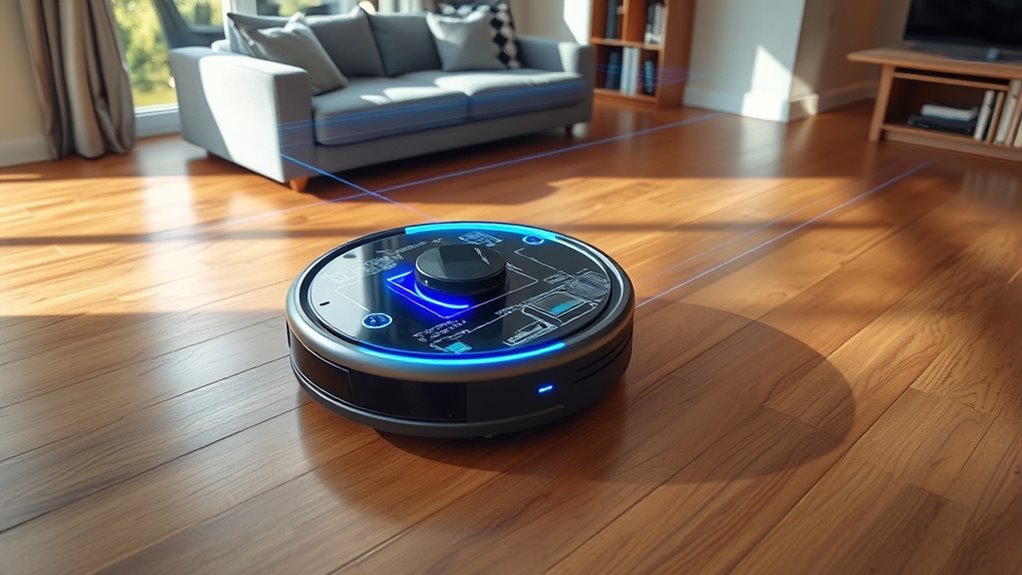
Advances in home mapping technology are poised to revolutionize how your smart devices understand and navigate your space. Expect more precise mapping with enhanced sensors and AI algorithms, making device movement smarter and faster. Voice commands will become more intuitive, allowing you to direct your devices effortlessly. User customization will also improve, letting you personalize maps for specific rooms or tasks, enhancing convenience and efficiency. Future developments may include real-time updates as your home changes, like furniture rearrangements or new objects.
| Feature | Benefit |
|---|---|
| Voice commands | Easier device control |
| User customization | Personalized, optimized home maps |
| Real-time updates | Adaptability to home changes |
| Enhanced sensors | Quicker, more accurate navigation |
Frequently Asked Questions
How Accurate Are Robot Vacuum House Maps Compared to Manual Surveys?
You might wonder how accurate robot vacuum house maps are compared to manual surveys. Generally, mapping accuracy varies, but modern robot vacuums use advanced sensors to create detailed layouts. While they may not match the precision of professional surveys, they’re usually sufficient for everyday needs like navigation and cleaning. Overall, survey comparisons show that robotic maps are quite reliable, though occasional errors can occur in complex or cluttered spaces.
Can the Vacuum’s Mapping System Detect Changes in Furniture Placement?
You might think your robot vacuum’s mapping system can’t detect furniture changes, but many models actually do. With advanced furniture detection, they recognize when you move pieces and trigger map updates. This guarantees your cleaning path stays accurate, even after rearranging. While some older models struggle with this, newer ones use sensors and AI to adapt, giving you a seamless, up-to-date map that reflects your current home layout.
What Types of Data Are Stored From My Home Maps?
You might wonder what data your vacuum stores from home maps. Typically, it saves spatial data like room layouts, furniture positions, and navigation routes. While this helps with cleaning efficiency, it raises privacy concerns, especially if data security isn’t strong. You should check your device’s privacy settings and manufacturer policies to guarantee your home map data stays protected and isn’t shared without your consent.
How Do Vacuum Maps Impact My Overall Home Security?
While vacuum maps offer convenience, they also introduce subtle privacy concerns. You might wonder how this data impacts your home security. These maps can reveal movement patterns and room layouts, potentially exposing sensitive areas. To protect yourself, make certain robust data security and understand your device’s privacy policies. Staying informed helps you enjoy the benefits of smart home technology without compromising your privacy or security.
Are There Ways to Customize or Restrict What the Vacuum Learns?
You can customize or restrict what your vacuum learns by adjusting privacy settings on the app or device. Many models let you limit data sharing or choose what areas to map, giving you control over sensitive spaces. Check your vacuum’s settings to turn off mapping features or disable cloud storage, ensuring your privacy is protected. Staying proactive helps you manage your home’s data and keeps your personal information secure.
Conclusion
Your vacuum’s hidden AI is like an unseen architect sketching your home’s blueprint, quietly shaping its future. As it maps each room, it becomes a silent guardian, ensuring every corner is cared for with precision. But remember, behind this invisible blueprint lies your privacy—carefully guarded like a treasured secret. Embrace the dance of technology and trust, knowing that your home’s new silent partner is shaping a smarter, cleaner future, one map at a time.