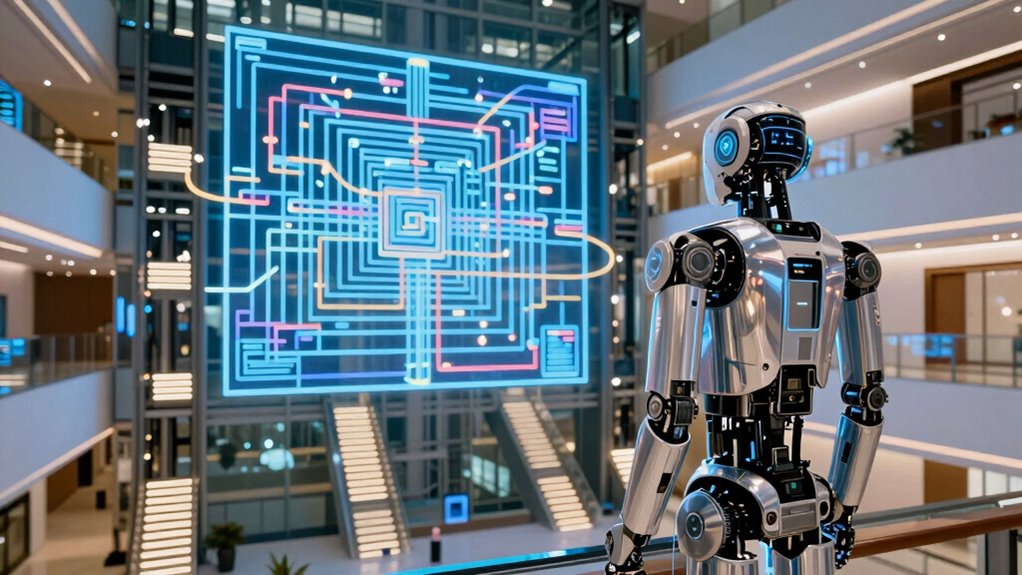

To understand how robots remember different levels, it’s key to know they combine sensors like LIDAR, cameras, IMUs, and signal sources to create layered maps of each floor. These systems fuse data to identify changes such as stairs or elevators and keep track of their position across levels. Advanced mapping techniques help robots update and connect these maps dynamically, ensuring accurate navigation. If you want to explore how these systems work together, keep exploring further.
Key Takeaways
- Robots use layered maps and recognize transition points like stairs and elevators to distinguish and navigate different floors.
- Sensor fusion combines LIDAR, cameras, IMUs, and signals to improve localization accuracy across multiple levels.
- Visual features and floor-specific signals help robots identify their current level and confirm location.
- Dynamic mapping updates internal maps with new features and inter-floor connections during exploration.
- Accurate multi-floor navigation relies on integrating data sources to track position and understand environment structure.
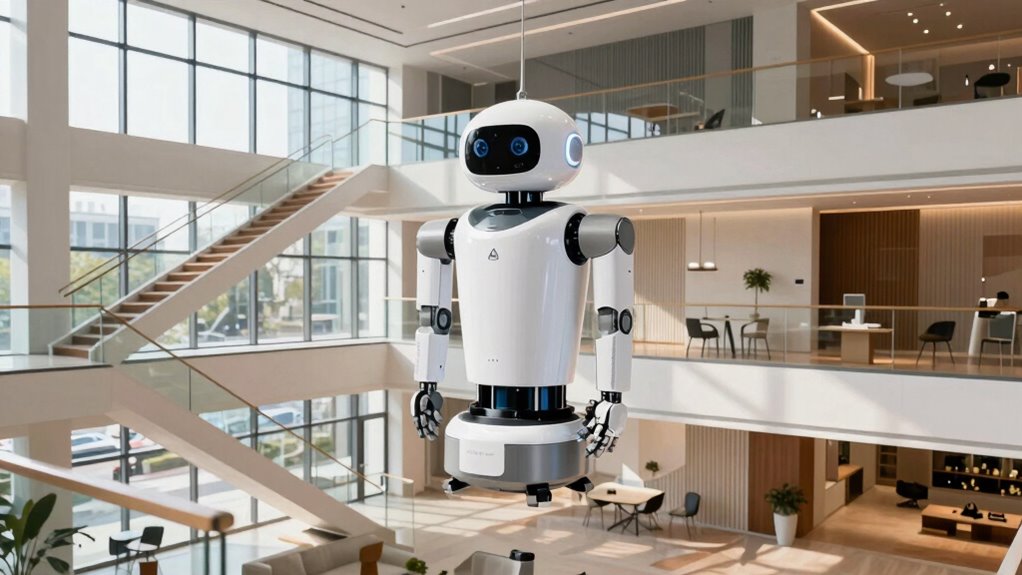
Have you ever wondered how robots or navigation systems can accurately move across multiple floors in complex buildings? It’s a fascinating challenge that involves sophisticated techniques like robot localization and data fusion. When a robot navigates multi-floor environments, it needs to understand not just its position on a single level but also how to facilitate seamlessly between floors. This requires it to maintain an accurate mental map of its surroundings, which is no small feat given the dynamic nature of indoor spaces. The key to this capability lies in combining various data sources to create a coherent picture of the environment, a process known as data fusion.
Robot localization is at the core of this process. It helps the robot determine where it is within a building, often by referencing sensors like LIDAR, cameras, inertial measurement units (IMUs), and sometimes Wi-Fi or Bluetooth signals. These sensors gather raw data about the environment, which the robot then interprets to pinpoint its position. However, in multi-floor settings, localization becomes more complex because the robot must distinguish between different levels. Elevators, stairs, ramps, and sometimes even moving platforms complicate the task, as the robot needs to recognize when it’s changing floors and update its position accordingly.
This is where data fusion becomes essential. Instead of relying on a single sensor or data source, the robot combines information from multiple sensors to improve accuracy and reliability. For example, visual data from cameras can help identify distinctive features on different levels, while inertial sensors track movement. When combined with floor-specific signals like Wi-Fi or Bluetooth beacons, the robot can more confidently determine its current floor and position on that level. Data fusion algorithms integrate these inputs, filtering out noise and discrepancies, to produce a stable, accurate localization.
Moreover, multi-floor mapping often involves creating a layered map that includes both the layout of each level and the connections between them. As the robot explores, it updates its map dynamically, learning new features and refining its understanding of the environment. When it reaches a staircase or elevator, it recognizes this transition point and updates its internal map to include the new floor. This layered approach ensures that navigation remains precise, even in complex, multi-level buildings with multiple pathways.
In essence, the ability of robots to remember different levels hinges on effectively combining diverse data sources through data fusion and maintaining precise localization. This integration allows them to navigate multi-floor environments confidently, making them invaluable for applications like building management, search and rescue, or delivery services. By continuously refining their internal maps and tracking their position across floors, robots can operate smoothly and safely in even the most intricate structures. A robust understanding of sensor integration and sophisticated data processing techniques further enhances their capability to perform these complex tasks efficiently.
Frequently Asked Questions
How Do Robots Distinguish Between Different Floors in Complex Buildings?
You can rely on a robot’s floor recognition to differentiate levels in complex buildings. It uses sensors like LiDAR and cameras to identify unique features such as elevators, staircases, or distinct wall patterns. Level differentiation is achieved through mapping algorithms that track changes in elevation and spatial cues. This way, the robot knows which floor it’s on and navigates seamlessly across multiple levels, avoiding confusion and ensuring accurate mapping.
What Sensors Are Most Effective for Multi-Floor Mapping?
You should use sensor fusion combined with laser scanning for effective multi-floor mapping. Sensor fusion integrates data from various sensors, enhancing accuracy, while laser scanning provides detailed 3D spatial information. Together, they allow your robot to distinguish floors reliably, even in complex environments. This combination guarantees precise navigation and mapping across multiple levels, helping your robot adapt seamlessly to multi-floor settings.
How Do Robots Handle Staircases Versus Elevators?
You watch as the robot encounters a staircase, its sensors quickly sensing the change. Using advanced sensor fusion, it detects the incline and plans a precise climbing route. For elevators, it recognizes the door signals, integrating visual and acoustic cues. This seamless robot navigation lets it adapt instantly, handling stairs with calculated maneuvers or waiting patiently at elevators, all while remembering each floor’s layout with remarkable accuracy.
Can Multi-Floor Maps Be Updated Automatically?
Yes, multi-floor maps can be updated automatically using advanced indoor navigation and mapping algorithms. When a robot detects changes in its environment, it can revise its maps in real-time, ensuring accuracy across different levels. This process involves continuous data collection and processing, allowing the robot to adapt to new obstacles or structural modifications seamlessly. Automated updates improve navigation efficiency and safety, making indoor robots more reliable in dynamic environments.
What Are Common Challenges in Multi-Floor Localization?
You’ll likely face challenges with multi-floor localization due to environmental variability and sensor fusion issues. Changes in lighting, furniture, or obstacles can throw off your robot’s sensors, making it harder to accurately determine its position across multiple levels. Sensor fusion helps by combining data from various sensors, but inconsistent data can still cause errors. To improve accuracy, you need to address environmental changes and optimize sensor integration.
Conclusion
Now that you understand how multi-floor mapping works, imagine what’s still hidden beneath the surface. Robots are continually improving, revealing new possibilities for navigation and safety. But as they become more advanced, questions arise about their limits and the mysteries they might uncover on unseen levels. Are we truly prepared for what’s next? The future of multi-floor mapping holds secrets yet to be revealed—and only time will tell what’s lurking just beyond our current understanding.