
TL;DR

Get decor and gifts delivered free with Prime
- Fast, free delivery on millions of items
- Prime Video, Amazon Music and more included
- Member-only deals all year
A Livingetc report draws on Norwegian designer Gudbjørg Simonsen’s advice for lighting homes during dark winters. Her approach favors varied, layered light and seasonal design over making every corner uniformly bright. The source does not provide quantified evidence that these choices improve mood or health.
Norwegian designer Gudbjørg Simonsen has shared advice on lighting homes for short winter days, arguing that rooms should use layered, varied light rather than be brightly illuminated from corner to corner. Her approach treats light and shadow as part of a home’s seasonal atmosphere, a perspective shaped by Norway’s limited daylight in winter.
In an interview published by Livingetc, Simonsen said a home should account for changing daylight across the year. Rather than treating darkness as a problem to eliminate, she said designers can work with shifts in light, shadow, color and materials. She described lighting as serving both practical and emotional purposes: helping people see, while also shaping how a room feels.
Simonsen recommends avoiding uniform illumination. She said she prefers variation, drawing on the way natural light creates brighter areas, gradual changes and shadows. In her view, leaving some spaces dimmer can give a room more depth than applying an even wash of light everywhere.
She also advocates layering different types of lighting. Task lighting can support activities such as working at a surface, while discreet or integrated fixtures can provide practical illumination without becoming the focus. Decorative or accent lights can draw attention to objects or create a more intimate atmosphere. The source excerpt begins this discussion but does not include all of Simonsen’s specific recommendations for the layers.
Lighting for Short Winter Days
The advice offers a design approach for households facing long evenings: plan for different lighting needs rather than relying on one central source. A combination of task and accent light can support practical activities while changing the feeling of a room, according to Simonsen.
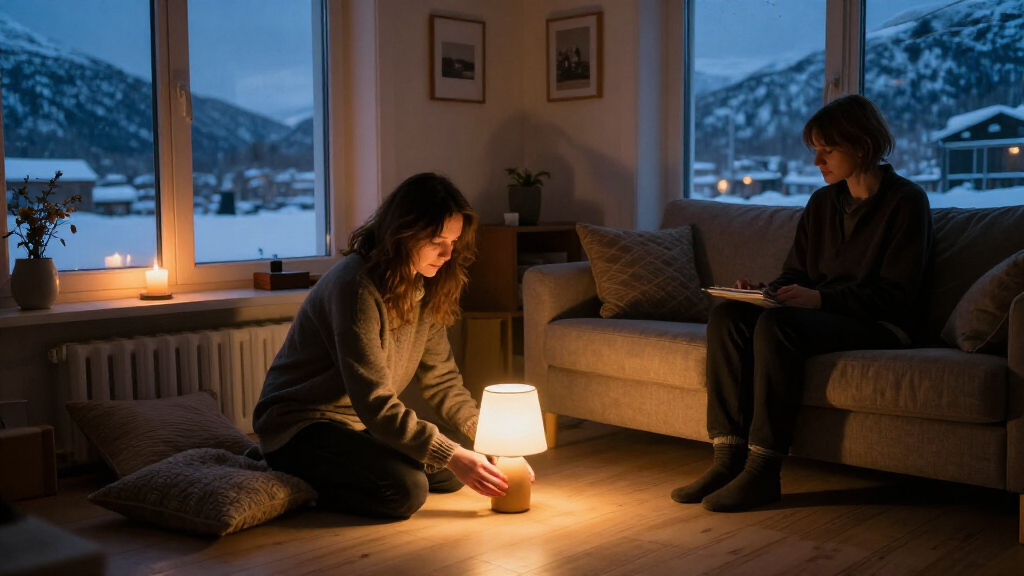
Her comments also distinguish functional brightness from atmosphere. She said a warmly lit window can signal that someone is home and create a sense of welcome. That is her interpretation of the emotional meaning of domestic light, not evidence in the source of a specific health effect. The report provides no measurements or clinical findings about lighting and mood.
Products Worth Considering

Philips Hue Bridge Pro Smart Lighting Hub

Philips Hue Festavia 65-Foot Smart LED String Lights, 250 Color-Changing Mini LEDs

Sonos Play Portable Wi-Fi and Bluetooth Speaker, White
As an affiliate, we earn on qualifying purchases.
Design Shaped by Norwegian Winters
The Livingetc article frames Simonsen’s advice around Norway’s seasonal daylight variation. It says December brings a maximum of about six hours of daylight per day in parts of the country, while the northernmost areas can experience periods with no daylight. These figures are presented as background in the report, not as a detailed national daylight survey.
Simonsen is based in Stavanger, according to the article, and says her projects consider both the surrounding environment and the client’s way of life. The report also describes her work as influenced by traditional Norwegian architecture. Its central point is that a lighting scheme should respond to seasonal changes rather than assume daylight remains constant.
“I don’t think we can design homes as though light remains constant throughout the year. Nor do I think the answer is to fight the darkness. We have to design with it.”
— Gudbjørg Simonsen, Norwegian designer, speaking to Livingetc
Limits of the Published Advice
The provided Livingetc material is an interior-design interview, not a study of lighting’s effects. It does not establish that the suggested approach improves mental health, sleep or other health outcomes, and it gives no measured comparison between layered and uniform lighting. The excerpt also ends during the discussion of lighting layers, so it is unclear what additional techniques the full article may include.
The source does not specify the report’s publication year, nor does it give a detailed location-by-location basis for its daylight figures. Simonsen’s comments are professional design guidance and personal interpretation; readers’ needs may differ with their room layout, activities and available daylight.
Applying the Ideas at Home
The report describes design principles rather than a formal program or a forthcoming product launch. Readers can start by identifying where they need focused light for tasks and where softer accent lighting could add atmosphere, then consider whether a room would benefit from contrast instead of uniform brightness. Simonsen’s advice is to make practical lighting discreet where possible and let light, shadow and materials contribute to the room’s character.
No follow-up announcement, additional research or next milestone is identified in the supplied source. The article’s recommendations remain design guidance, and the fuller set of details is not available in the excerpt provided.
Key Questions
What is the main Norwegian lighting tip in the report?
Gudbjørg Simonsen recommends variation rather than illuminating every part of a room evenly. She suggests using brighter areas, softer transitions and shadows to create depth.
What does layered lighting mean here?
It means using lights for different purposes, including task lighting for activities and accent lighting to draw attention to features or add atmosphere. The supplied excerpt does not contain the full list of techniques from the article.
Does the report show that this lighting approach improves mood?
No. Simonsen describes how lighting can shape a room’s feel, but the report provides no clinical evidence or measured results about mood or health.
Why does the article focus on Norway?
The report points to Norway’s short winter days, including areas that receive about six hours of daylight in December and northern locations that can have periods without daylight. It presents this seasonal experience as relevant to Simonsen’s design perspective.
Source: rss