AI predictive home automation learns your routines by analyzing your daily habits with advanced analytics and voice assistants like Alexa or Google Assistant. It anticipates your needs, automatically adjusting lighting, temperature, and devices for maximum comfort and efficiency. Over time, it becomes more accurate, recognizing changes in your schedule and adapting accordingly. This smart system turns your home into an intuitive partner that simplifies your life—discover how it can transform your space as you explore further.
Key Takeaways
- AI systems analyze user data to identify daily routines and habits for proactive home environment adjustments.
- Voice assistants enable easy modifications and overrides of automated routines based on user preferences.
- Predictive analytics detect deviations from normal patterns, allowing the system to adapt to lifestyle changes.
- Learning routines over time enhances energy efficiency by reducing unnecessary device usage.
- Continuous adaptation creates a personalized, seamless, and efficient smart home experience for users.
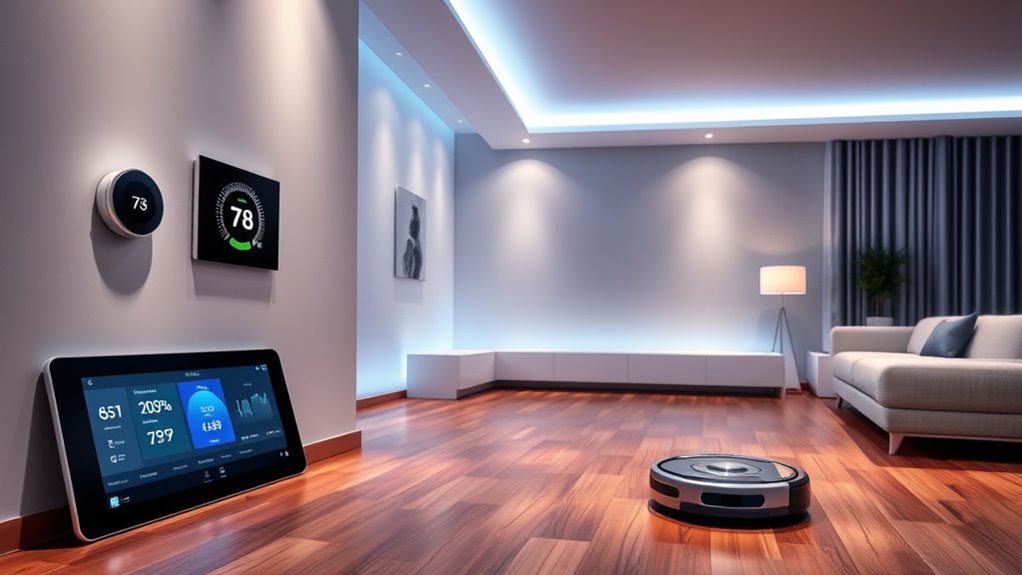
AI predictive home automation is transforming the way you interact with your living space by anticipating your needs before you even ask. Imagine walking into your home and having the environment adjust automatically—lights dimmed just right, your favorite music softly playing, and the temperature set to your preferred comfort level. This seamless experience is possible thanks to advanced voice assistants and predictive analytics working behind the scenes. Voice assistants like Alexa, Google Assistant, or Siri have become central to this smart home evolution, listening and responding to your commands while also learning from your routines. Over time, these devices analyze your patterns, habits, and preferences to predict what you’ll need next, often before you even voice it out loud.
Predictive analytics plays a vital role here, sifting through vast amounts of data to identify trends and make accurate forecasts. For example, if you typically turn on the coffee maker every morning at 7 a.m., your home’s system will recognize this pattern and start brewing coffee automatically on those days. If you usually arrive home from work around 6 p.m., your smart thermostat can begin warming the house in advance, ensuring a cozy environment when you walk through the door. This proactive approach not only enhances your comfort but also improves energy efficiency by reducing unnecessary usage when you’re not around or during off-peak hours.
Additionally, learning routines helps the system become more precise over time, ensuring your home adapts seamlessly to your evolving lifestyle. By learning your routines, the system can also adapt to changes over time. Suppose you decide to sleep in on Saturday or go on vacation; the predictive analytics detect these deviations and adjust accordingly, preventing unnecessary heating, cooling, or lighting. Voice assistants, integrated into this ecosystem, act as your interface, making it easy to modify routines or override predicted actions when needed. You can say, “Cancel my morning routine,” and the system will promptly update its behavior.
This intelligent automation creates a more efficient, personalized environment that responds intuitively to your lifestyle. It reduces manual adjustments, saving you time and energy while maintaining comfort. As these systems become more sophisticated, the accuracy of their predictions improves, and your home’s automation becomes more tailored. The synergy of voice assistants and predictive analytics allows your living space to evolve from a static environment into a dynamic partner that learns and adapts alongside you. Ultimately, this technology simplifies daily life, giving you back precious time and peace of mind, all while optimizing your home’s performance.
Frequently Asked Questions
How Secure Is My Data in Predictive Home Automation Systems?
Your data in predictive home automation systems is fairly secure if providers use data encryption and follow strict privacy policies. Encryption protects your information during transmission and storage, while privacy policies clarify how your data is handled and who can access it. To stay safe, choose systems from reputable companies that prioritize security, regularly update their software, and give you control over your privacy settings.
Can AI Adapt to Sudden Changes in Household Routines?
Yes, AI can adapt to sudden changes in your household routines through adaptive learning. When your routines shift unexpectedly, the system quickly recognizes the new patterns and adjusts its predictions, offering routine flexibility. This responsiveness helps maintain efficiency and comfort, ensuring your smart home remains aligned with your current lifestyle. With continuous learning, your automation system becomes more resilient, seamlessly accommodating your evolving daily activities.
What Is the Installation Process for Ai-Powered Home Automation?
You start by choosing compatible devices and ensuring they support voice calibration for seamless integration. Next, you install the hub or app, connect your devices via Wi-Fi or Bluetooth, and follow setup prompts. During setup, you calibrate voice recognition for accuracy. Make sure all devices are compatible with your system to avoid issues. Once configured, your AI-powered home automation learns routines, making your home smarter and more efficient.
How Does AI Handle Multiple Users With Different Preferences?
You might think AI would drown in user preferences, but it cleverly manages multiple users through user customization. It tracks individual routines and adjusts settings accordingly, even when preferences conflict. When conflicts arise, the system prioritizes based on recent activity or user-defined rules, ensuring everyone’s comfort. So, you get a surprisingly harmonious home, where AI calmly juggles your preferences—proof that even chaos can be organized with a little smart automation.
What Are the Costs Associated With Implementing Predictive Automation?
The costs of implementing predictive automation include initial setup, which covers hardware, software, and installation fees. You’ll also need to ensure ongoing cost analysis for updates, data storage, and integration. Maintenance expenses can add up over time, as you’ll want to keep the system running smoothly and securely. Budgeting for these costs ensures you can enjoy the efficiency benefits without unexpected financial surprises.
Conclusion
As you unbolt the potential of AI predictive home automation, you’re stepping into a future where routines become smarter, more seamless. But what if the system learns more than you expect? The line between convenience and privacy blurs, leaving you wondering—are you truly in control? As your home adapts in ways you can’t yet imagine, one thing’s certain: the journey toward efficiency is only just beginning. Are you ready to see where it leads?