
Finding the best patient lifts for home use involves balancing safety, ease of use, and affordability. The top overall pick, the Electric Patient Lift with Foldable Frame, offers versatile portability and high weight capacity, making it suitable for most home setups. The VOCIC Electric Patient Lift stands out for its foldability and wireless control, ideal for those prioritizing compact storage and modern features. Meanwhile, the Invacare Hydraulic Lift provides a reliable, manual option with a lower price point for fewer electronic dependencies. Keep in mind that choosing the right lift involves tradeoffs between power, portability, ease of assembly, and cost. Continue reading for a detailed breakdown of these options and what fits your specific needs.
Key Takeaways
- The top-ranked lifts combine portability with high weight capacity, making them suitable for varied home environments.
- Wireless controls and foldable designs significantly improve ease of use and storage, especially for limited spaces.
- Manual hydraulic lifts remain cost-effective and reliable, but generally lack the convenience of electric models.
- Weight capacity varies from 300 to 500 pounds, so selecting a lift that matches the user’s weight is essential for safety.
- Additional features like emergency stop functions and support for different transfer methods enhance safety but can add to the cost.


More Details on Our Top Picks
Electric Patient Lift, Foldable Patient Lift for Home Use, Portable Electric Patient Transfer Lift, 500lbs Electric Body Transfer Lift w/Commode Sling, Installation Free,Emergency Stop
This electric lift stands out for its combination of portability, high weight capacity, and ease of storage, making it a top choice for home caregivers needing a reliable transfer aid. Compared to the VOCIC AY05, it offers a higher maximum weight capacity of 500 lbs and features an adjustable, foldable base that simplifies storage in small spaces. Its 360° rotating sling bar and included commode sling enhance transfer versatility, while the waterproof IPX6 motor supports durability. The lift’s manual lowering and emergency stop add safety, but its bulkier size may challenge users with very tight spaces. Its powerful motor ensures smooth, effortless transfers, but the heavier weight and wider base could limit maneuverability in narrow rooms. This pick makes the most sense for families needing a sturdy, space-saving lift capable of handling heavier patients without sacrificing ease of transport or setup.
Pros:- Supports up to 500 lbs for heavy patients
- Foldable design for easy storage and transport
- 360° rotating sling bar for versatile transfers
- Waterproof motor enhances durability
Cons:- Wider base may be difficult to maneuver in narrow spaces
- Heavier weight than some portable lifts may challenge some users
Best for: Caregivers who require a sturdy, versatile lift capable of supporting up to 500 lbs and need foldability for storage.
Not ideal for: Homes with extremely tight spaces where a more compact lift is necessary, due to its adjustable but relatively wide base.
- Maximum Weight Capacity:500 lbs
- Base Width (adjustable):23.6″ to 31.5 inches
- Lift Height:Not specified
- Motor Waterproof Rating:IPX6
- Sling Included:Commode nylon sling
- Lifting Power:8000N
- Weight:85 pounds
- Assembly:Installation free
- Emergency Features:Emergency stop, manual lowering
Bottom line: This lift is ideal for families needing a high-capacity, easy-to-store option with versatile transfer capabilities.
VOCIC Electric Patient Lift for Home, Floor-to-Bed Transfer Aid for Elderly, Foldable Patient Lift with Wireless Lithium Handset, Manual Emergency, 330lbs Capacity, Includes Full Body Mesh Sling, AY05
This model excels for its lightweight design and remote operation, making it especially suitable for caregivers who need a portable lift that can handle floor-to-bed transfers with minimal effort. Compared with the Invacare Hydraulic Lift, the VOCIC AY05 features a detachable lithium handset that charges quickly and offers wire-free control, reducing fatigue during use. Its extended vertical range of 29.5 to 61 inches allows safe lifting from the floor after falls, a critical feature for home safety. The foldable frame and low profile (just 23 lbs) make it easy to store and move around tight spaces, but the lift’s maximum height of 61 inches may be limiting for taller beds. Its 330 lbs capacity suits most adult patients, but not very heavy individuals. The manual emergency override guarantees safety if power fails, but the lift’s relatively lower capacity and height limit its use for very large or tall patients. This makes it ideal for users seeking a lightweight, portable lift with floor rescue capabilities.
Pros:- Extremely lightweight at 23 lbs for easy handling
- Wireless lithium handset with quick charge in 3 hours
- Extended vertical range for floor-to-bed transfer
- Foldable frame for convenient storage
Cons:- Supports only up to 330 lbs, limiting use for heavier patients
- Maximum lift height of 61 inches may be insufficient for taller beds
Best for: Home caregivers needing a lightweight, remote-controlled lift for floor-to-bed transfers up to 330 lbs in small or cluttered spaces.
Not ideal for: Homes with taller beds or patients over 330 lbs, due to height and weight restrictions.
- Weight:23 lbs
- Maximum Capacity:330 lbs
- Lift Height Range:29.5 to 61 inches
- Battery Type:Wireless Lithium
- Charging Time:3 hours
- Control:Wireless remote
- Frame Foldable:Yes
- Waterproof:Yes (IP68)
- Assembly:No tools required
Bottom line: This lift is best suited for those needing a portable, easy-to-control device for safe floor-to-bed transfers within weight limits.
Invacare Hydraulic Patient Lift, Lightweight Transfer Lift Chair with 450 lb Weight Capacity, Bent Mast for Safer Transfers, 6-Point Padded Swivel Bar, Floor-to-Bed Height Range for Fall Recovery
This hydraulic lift combines a unique bent mast design with lightweight construction, making it a strong candidate for safe, comfortable patient transfers at home. Compared to electric options like the VOCIC AX07, it offers a manual hydraulic system, which eliminates battery concerns but requires physical effort for operation. Its 450 lbs capacity and padded swivel bar make it suitable for most adult patients, and the bent mast design reduces the feeling of confinement during transfers—more comfortable than traditional straight-mast lifts. Its 20 to 64-inch height range allows safe retrieval from the floor or bed, but the manual pump handle may be tiring for frequent use. Unlike electric lifts, it does not require power, but the need for manual effort can be a drawback for caregivers with limited strength. Overall, this lift is ideal for those who prioritize safety and simplicity without reliance on electricity.
Pros:- Supports up to 450 lbs for broad patient range
- Unique bent mast design for comfort and safety
- Lightweight at 68 lbs for easy maneuvering
- Manual hydraulic system with no power needed
Cons:- Requires physical effort to operate the hydraulic pump
- Limited lift height of 64 inches may not suit taller beds
Best for: Caregivers seeking a lightweight, manual hydraulic lift with a focus on safety and comfort for patients up to 450 lbs.
Not ideal for: Homes where frequent or high-height transfers are needed, due to the manual pumping effort required.
- Weight:68 lbs
- Capacity:450 lbs
- Lift Height Range:20 to 64 inches
- Mast Design:Bent
- Type:Hydraulic
- Frame Material:Steel
- Padded Swivel Bar:Yes
- Locking Casters:No
- Assembly:Lightweight, easy
Bottom line: This lift is best for those valuing safety, simplicity, and comfort over electric convenience, especially in settings with limited power access.
ProHeal Electric Lift – Safe and Easy Full Body Patient Transfer Lifter for Home Use and Facilities – Floor, Low Bed and Chair Lifting, 500 Pound Weight Capacity, 6 Point Spreader Bar
The ProHeal Electric Lift earns its spot for being compact yet powerful, supporting up to 500 lbs and fitting underneath most beds, making it ideal for small home environments. Its 6-point spreader bar offers compatibility with a wide range of slings, and the simple button operation allows effortless lifting and lowering, comparable to larger models like the MediHoist. Its safety features—dual rear locking casters and manual emergency lowering—enhance security, while the sturdy construction and 3-year warranty promise durability. However, its compact size limits maximum lift height, which might be inconvenient for taller beds or users needing higher lifts. The modular design simplifies parts replacement, but the lift’s small footprint could make repositioning in tight spaces slightly awkward. This makes it perfect for those needing a space-efficient, high-capacity electric lift in limited room settings.
Pros:- Supports up to 500 lbs for heavy patients
- Fits underneath most beds for space efficiency
- Simple button controls for easy operation
- Compatible with various slings
Cons:- Limited maximum lift height may be insufficient for taller beds
- Small size may challenge repositioning in very tight spaces
Best for: Home users needing a compact, high-capacity electric lift that fits under beds and maneuvers easily in small rooms.
Not ideal for: Homes with very high beds or those requiring taller lifts, due to limited maximum height.
- Weight Capacity:500 lbs
- Size:Compact
- Maximum Lift Height:Not specified, suitable for low beds
- Number of Sling Points:6
- Warranty:3 years
- Frame Material:Steel
- Casters:Dual rear locking
- Operation:Electric with manual emergency
- Assembly:Easy, tool-free
Bottom line: This lift is ideal for small rooms where space-saving and high capacity are priorities without sacrificing electric convenience.
Joerns Hoyer Advance Portable Patient Lift | Electric Power | Lightweight and Robust | Safe Working Load 340 Lbs
This lift stands out for its exceptional portability, thanks to its lightweight aluminum frame and a design that requires no tools for folding. Compared with the Vive Lift, it offers a more compact profile and easier transport, making it ideal for home environments where space and mobility matter. Its multiple transfer options—from floor transfers to vehicle loading—are versatile, but the foldability means it sacrifices some stability found in larger, stationary lifts like the Invacare Hydraulic Lift. The unique swan-leg design allows closer access around furniture, which enhances comfort and ease of positioning the patient. The 340 lbs weight capacity is sufficient for most users, and the premium build quality ensures durability. However, the lift’s portability comes with a tradeoff: it’s less suited for very heavy or bariatric patients, and the smaller base may limit stability in some scenarios.
Pros:- Extremely lightweight at just under 70 lbs, easy to move and store
- No tools required for folding, facilitating quick setup and breakdown
- Versatile transfer options from floor to vehicle or furniture
Cons:- Less stable than larger, fixed lifts, potentially limiting safety with very heavy users
- Limited weight capacity compared to bulkier models, not suitable for bariatric patients
Best for: Home caregivers needing a lightweight, portable lift for frequent transfers across different rooms or vehicles
Not ideal for: Users requiring maximum stability for bariatric patients or for permanent, heavy-duty lifting in a fixed location
- Weight Capacity:340 lbs
- Lift Type:Electric portable
- Weight:69.9 lbs
- Foldable:Yes
- Maximum Height:Not specified
- Material:Aluminum body
Bottom line: This lift is perfect for users who prioritize portability and ease of storage over maximum stability and weight capacity.
Patient Lift Transfer Chair – Electric Assist Lift Aid for Home Care Use – Portable Folding for Car – Transport Wheelchair for Seniors, Adults & Disabled
This model excels in combining portability with adjustable features, making it ideal for caregivers who need to transfer patients between multiple settings without heavy lifting. Compared to the Joerns Hoyer, it offers a more compact foldable design that fits easily into car trunks, but its maximum weight capacity of 290 lbs is lower, which may limit use with bariatric patients. Its electric height adjustment (33.86-47.64 inches) and adjustable base width (19.68-33.46 inches) provide excellent flexibility across different environments. The inclusion of a soft, skin-friendly cushion improves patient comfort, yet the chair’s reliance on caregiver assistance means it’s not suitable for patients who cannot support any weight. The product’s easy assembly and water-resistant features are strong advantages, but the smaller size and lower capacity mean it’s less appropriate for larger users or long-term, heavy-duty use.
Pros:- Folds easily to fit into most car trunks for travel
- Adjustable height and width for versatile use in different environments
- Includes a soft, skin-friendly cushion for patient comfort
- Water-resistant and quick to assemble
Cons:- Maximum weight capacity of 290 lbs limits use for bariatric patients
- Relies on caregiver support; not a standalone lifting solution
Best for: Families or caregivers needing a lightweight, foldable lift for travel and everyday transfers with moderate patient weight
Not ideal for: Caregivers managing bariatric patients or requiring a lift for constant, heavy-duty use
- Weight Capacity:290 lbs
- Lift Height Range:33.86-47.64 inches
- Folded Size:Fits into most car trunks
- Material:High-quality steel
- Weight:75 lbs
- Max Width Adjustment:19.68-33.46 inches
Bottom line: This lift makes the most sense for those who need a portable, adaptable device for moderate transfers on the go.
Vive Electric Patient Lift for Home Use with Sling – Portable, Adjustable Medical Patient Lift for Home Use – Electric Sit to Stand Chair for Elderly, Adults & Handicap
The Vive electric lift stands out for its focus on safety and user-friendly features, including emergency stop, soft start/stop, and a high-strength mesh sling supporting up to 400 lbs. Unlike the Joerns Hoyer, it offers a remote-controlled electric adjustment, making transfers more effortless. The removable, rechargeable battery adds convenience, while the adjustable base and height (from 31 to 68 inches) cater to various environments. Its sleek, compact design allows it to blend into home spaces easily. However, the lift’s reliance on a caregiver to operate and its somewhat higher price point can be drawbacks for those seeking a more budget-friendly or fully autonomous device. The product’s compatibility with HSA/FSA funds makes it accessible, but the size and weight capacity might limit use to certain patient profiles.
Pros:- Supports up to 400 lbs, suitable for most users
- Remote control for easy height adjustment
- Removable, rechargeable battery adds portability
- Includes a high-strength mesh sling for comfort and durability
Cons:- Relies on caregiver operation; not fully autonomous
- Higher price compared to manual or simpler lifts
Best for: Home caregivers who prioritize safety, ease of use, and adjustable features for moderate to heavy users
Not ideal for: Individuals seeking a fully autonomous, stand-alone lift without caregiver assistance
- Weight Capacity:400 lbs
- Lift Height Range:31-68 inches
- Battery:Removable, rechargeable
- Remote Control:Yes
- Material:Steel frame
- Weight:Approx. 80 lbs
Bottom line: This lift is ideal for those who need a safe, adjustable, and easy-to-operate device for moderate to heavy patients at home.
Vive Mobility Sit to Stand Patient Lift for Handicapped – Stand Assist Lift Aid for Home Care Use – Elderly Lift Assist Transfer Device – Transport Chair Stand Assist for Seniors, Adults & Disabled
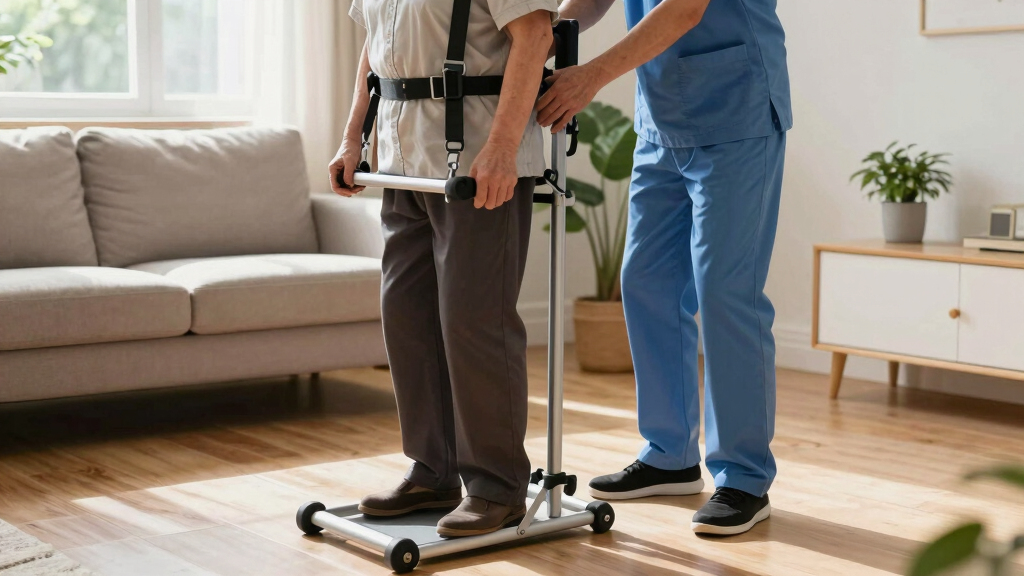
This stand assist lift is designed for patients who can support most of their weight but need help with standing and transferring. It offers a sturdy steel frame supporting up to 400 lbs, with soft foam-enclosed handrails and cushioned seat for comfort. Its dual-locking brakes and side support hooks enhance safety during transfers. Compared to the electric models, it is manually operated, which makes it more affordable and requires less maintenance but less convenient for repetitive transfers. Its 26-inch width makes it suitable for most doorways, but users with very narrow spaces may find it less suitable. The product’s simplicity and reliability make it a good choice for basic standing assistance, although it may not be ideal for those needing full-body lifts or for users with limited support capacity.
Pros:- Supports up to 400 lbs, suitable for most users
- Manual operation reduces complexity and cost
- Dual-lock brakes ensure safety during transfers
- Compact width fits most doorways
Cons:- Requires caregiver strength and effort, not motorized
- Limited to support standing, not full-body lifting
Best for: Caregivers assisting patients who can partially support themselves and need stable, manual standing support
Not ideal for: Patients who cannot support any weight or require fully powered lifts
- Weight Capacity:400 lbs
- Width:26 inches
- Material:Steel
- Locking Brakes:Dual
- Support Type:Stand assist
- Operation:Manual
Bottom line: This device suits those who need a reliable, manual stand assist with straightforward operation and safety features.
VOCIC Sit to Stand Lift, One-Step Stand Assist Lift for Elderly, Patient Lift Chair Transport Unit with Wheels, Fall Prevention & Muscle Building, AY03 2026 Upgraded
The VOCIC stand assist lift emphasizes stability and safety, with reinforced steel construction supporting up to 400 lbs and features like soft foam grips and padded cushions for comfort. Its dual-locking casters prevent unwanted movement during transfers, akin to the safety features in the Vive model but with a more robust frame suitable for home and professional settings. The low-profile 6cm base allows for easy sliding under furniture, and the adjustable knee pad adds ergonomic support. Compared to the Vive lift, it offers similar weight capacity but with a focus on enhanced stability and muscle support during transfers. The straightforward assembly and clear instructions make it accessible, yet the manual operation and lack of electric adjustment mean it’s less convenient for repetitive or frequent use and may require caregiver effort.
Pros:- Supports up to 400 lbs with reinforced steel frame
- Dual-lock casters improve safety during transfers
- Adjustable knee pad for ergonomic positioning
- Low-profile base fits under furniture easily
Cons:- Manual operation requires caregiver effort
- No electric adjustment, less suitable for frequent transfers
Best for: Users who need a stable, ergonomic stand assist with added safety features in a home setting
Not ideal for: Patients unable to support any weight or requiring full electric lift functionality
- Weight Capacity:400 lbs
- Base Height:6cm
- Locking Casters:Dual
- Support Type:Stand assist
- Frame Material:Reinforced steel
- Support Support:Supports up to 400 lbs
Bottom line: This lift is best for caregivers seeking a stable, ergonomic, and safety-focused stand assist solution for moderate to heavy users.
VOCIC Upgrade Electric Chair Lift with Wheels, Get Up from Floor, Portable Lift Assist Devices for Elderly, Includes 2 Types Suction Cups, Support Up to 300 LBS, No Assembly, AX10
This lift stands out for its innovative wheel design, making it easier for caregivers to reposition and transport the lift around the home without heavy lifting. Its adjustable seat height from 2.9″ to 19.7″ simplifies getting individuals up from the floor, especially for those prone to falls or with muscle weakness. Compared to the VOCIC Foldable Patient Lift, this model offers better mobility with wheels but is heavier and less compact, which may limit maneuverability on carpets due to wheel size. The waterproof motor and remote control enhance safety and usability in wet environments, like bathrooms. However, the size and weight—although equipped with wheels—may make it less ideal for smaller caregivers or homes with narrow doorways. This pick makes the most sense for families needing a sturdy, mobile lift for floor-to-bed or floor-to-chair transfers, especially on hard floors or tiles.
Pros:- Easy repositioning with integrated wheels, reducing caregiver effort
- Supports up to 300 lbs, suitable for most users
- Waterproof design enhances safety in wet environments
Cons:- Wheels are smaller for carpets, limiting mobility on plush flooring
- Heavier weight at over 16 ounces, potentially cumbersome for some users
Best for: Caregivers assisting with floor-to-stand lifts on hard, smooth surfaces.
Not ideal for: Homes with tight spaces or thick carpets where larger wheels struggle to roll smoothly.
- Support Capacity:300 lbs
- Remote Control:Yes
- Waterproof Rating:IP68
- Height Adjustment:2.9″ to 19.7″
- Wheels:Small, rubberized
- Assembly:No
- Material:Plastic with waterproof components
- Battery:Rechargeable
Bottom line: This lift is ideal for those needing a durable, mobile device for safe floor-to-stand transfers on smooth surfaces.
VOCIC Electric Patient Lift for Home Use, Collapsible Patient Lift for Elderly, Easy Disassemble, 330LBS Weight Capacity, Medical Sling Included, AY02 PRO
This model makes the list for its collapsible design, allowing quick disassembly for easy storage and transport, which is a step up from bulkier, non-folding lifts like the Carearise S1. Its adjustable base width enables navigation around large furniture, making it suitable for varied home layouts. The dual-point folding structure and tool-free disassembly facilitate compact storage, ideal for homes with limited space. Compared with the VOCIC AX10, the AY02 PRO offers easier disassembly but is slightly less robust in support capacity, which might matter for heavier users. Its quiet, stable maneuvering and padded sling enhance user comfort, though the base width adjustment can add complexity for less experienced caregivers. This lift is best suited for families seeking a space-saving, easy-to-store lift for multiple transfer scenarios.
Pros:- Quick, tool-free disassembly for compact storage
- Adjustable base width for maneuvering around furniture
- Quiet operation with stable wheels
Cons:- Supports up to 330 lbs, limiting for very heavy users
- Slightly more complex setup compared to fixed models
Best for: Families needing a portable, disassemblable lift for frequent room-to-room transfers.
Not ideal for: Homes with very high weight requirements over 330 lbs or users requiring heavy-duty lifting.
- Support Capacity:330 lbs
- Disassembly:Yes, tool-free
- Base Width Adjustment:Yes
- Silent Casters:Yes
- Material:Steel and plastic
- Battery:Built-in rechargeable
- Weight:Supports adult users
- Assembly:Minimal, no tools needed
Bottom line: This pick is excellent for those prioritizing easy storage, transport, and adaptable maneuverability in a home setting.
2IN1 Electric Patient Lift with Stand-Up Assist Rehabilitation-2 Slings Included-Multi-Functional Battery Powered Body Transfer Lift for Home,Wheelchair Toilet Car-Elderly, Disabled, Recovery
This lift’s dual-functionality—combining full transfer and stand-up modes—distinguishes it from single-purpose lifts like the AX10. Its powerful 8000N motor provides reliable lifting for heavier or more challenging transfers, making it suitable for long-term care and rehab scenarios. The 360° rotating hook and adjustable base width improve positioning flexibility during complex or multi-scene transfers, including wheelchair, bed, toilet, or car transfers. Compared with the VOCIC AY02 PRO, it offers enhanced safety features such as an emergency stop and manual lowering, but its bulkier design might be less convenient for homes with narrow doorways. The included slings and support for recovery training make it ideal for patients improving mobility, though its price and size may be a barrier for occasional use. This lift is best for families seeking a multi-functional, recovery-focused device capable of handling diverse transfer needs.
Pros:- Dual functionality for transfer and rehab support
- Strong 8000N lifting capacity handles heavy users
- 360° rotating hook allows flexible positioning
Cons:- Bulkier and heavier, less suited for tight spaces
- Higher price point compared to simpler lifts
Best for: Caregivers supporting rehabilitation or multiple transfer scenarios in larger or open-floor homes.
Not ideal for: Homes with limited space or those needing only occasional lifts with minimal features.
- Lift Capacity:8000N (approximately 1800 lbs)
- Modes:Full transfer and stand-up rehab
- Rotating Hook:Yes
- Emergency Stop:Yes
- Battery Powered:Yes
- Included Slings:2 types
- Support Scene:Multiple (bed, wheelchair, toilet, car)
- Material:Steel and polyester
Bottom line: This lift excels for families requiring a versatile, powerful device that supports both transfers and recovery training in spacious home environments.

How We Picked
This lineup was chosen based on a combination of performance, usability, build quality, and safety features. We prioritized models that balance power and portability, ensuring they suit varying home layouts and user needs. Ease of assembly and maintenance were also key factors, as well as overall value for the price. Each product was compared against others for weight capacity, control options, and special features like foldability or battery life. The ranking reflects which lifts best serve typical home care scenarios, offering options for beginners, budget-conscious buyers, and those seeking premium features.Factors to Consider When Choosing Best Patient Lifts For Home Use
Choosing the best patient lift for home use requires considering several factors beyond just capacity. The right lift should match the user’s mobility level, space constraints, and transfer routines. Cost is important, but investing in safety features and ease of use can save money and frustration in the long run. Think about whether you prefer electric or hydraulic models, and whether portability or stability is more critical for your situation. Understanding these broader considerations ensures you select a lift that improves safety and independence effectively.Weight Capacity and User Size
The primary consideration is ensuring the lift can support the user’s weight safely. Most home lifts support between 300 and 500 pounds, but choosing a model with a higher capacity provides extra margin for safety. Additionally, consider the user’s size and mobility; some lifts have adjustable slings and support configurations that accommodate different body types. Overloading a lift can cause safety risks and equipment damage, so always select a model that exceeds the user’s weight by a comfortable margin.Ease of Use and Controls
Ease of operation is vital for safe transfers. Electric lifts with wireless remotes or simple controls reduce effort and minimize user error. Manual hydraulic models are less complex but require more physical effort, which might be problematic for some caregivers or family members. Consider the user’s dexterity and strength when choosing controls—features like emergency stop buttons and battery backup add safety. Make sure the lift’s interface is intuitive, especially if multiple caregivers or family members will operate it.Portability and Storage
Many home environments benefit from lightweight, foldable, or collapsible lifts that can be stored easily when not in use. Electric models with foldable frames are ideal for small spaces, but ensure they remain stable when deployed. Hydraulic lifts tend to be bulkier but don’t require charging or batteries. Think about your available storage space and whether you need to move the lift frequently between rooms or vehicles. Portability features often come with tradeoffs in stability or capacity, so balance these factors based on your usage.Safety Features and Accessories
Additional safety features—such as emergency stop buttons, anti-slip grips, and support for fall prevention—are key for home use. Many models include supportive slings or harnesses, which should be chosen based on the user’s specific needs. Compatibility with various slings and accessories adds versatility, but check for ease of attachment and cleaning. Investing in models with built-in safety features can prevent accidents, especially for users with limited mobility or balance issues.Cost and Maintenance
Prices for patient lifts vary widely, from budget hydraulic models to sophisticated electric systems. While cheaper lifts may seem attractive, they often lack advanced features or durability. Consider the total cost of ownership, including maintenance, replacement parts, and battery charging. Durability and ease of cleaning are also important, as home lifts need regular upkeep to maintain safety standards. Sometimes paying more upfront for a reliable, feature-rich model can reduce long-term costs and frustrations.Frequently Asked Questions
How do I choose between electric and hydraulic patient lifts?
Electric lifts provide greater ease of use with remote controls and often feature foldable designs, making them a popular choice for home settings. Hydraulic lifts, on the other hand, are typically less expensive, require no batteries, and are simpler mechanically, which can translate to fewer breakdowns. Your choice depends on priorities like convenience, budget, and space. If you need frequent, easy transfers, electric models generally offer more comfort and safety, while hydraulic options suit budget-conscious buyers willing to exert more manual effort.
What safety features should I look for in a patient lift?
Safety features such as emergency stop buttons, anti-slip grips, and secure slings are essential. Also, look for lifts with sturdy safety locks, battery indicators, and support for fall prevention accessories. These features help prevent accidents during transfers, especially when dealing with users who have limited strength or stability. Safety should always be prioritized over additional bells and whistles, as a well-designed lift minimizes the risk of injury to both user and caregiver.
Can I use a patient lift in small or cluttered spaces?
Many modern lifts are designed with portability and foldability in mind, making them suitable for small or cluttered areas. Look for models with compact frames, foldable bases, or lightweight construction that can be easily moved and stored. However, ensure there is enough clearance for safe operation—some lifts require extra space for full extension or maneuvering. Carefully measure your available space and choose a model that balances size, stability, and ease of use accordingly.
Are manual hydraulic lifts reliable enough for daily home use?
Manual hydraulic lifts are known for their simplicity and durability, often requiring less maintenance than electric models. They are reliable in terms of mechanical function and can be more budget-friendly. However, they demand physical effort to operate, which may be challenging for some caregivers or users. For frequent or daily transfers, electric lifts may reduce fatigue and improve safety, but hydraulic lifts remain a solid, cost-effective choice when used within their operational limits.
What features make a patient lift suitable for multi-user households?
For households with multiple caregivers or family members, ease of operation and adjustable features are important. Look for lifts with intuitive controls, adjustable sling supports, and lightweight designs for easy handling. Battery-powered models with remote controls simplify transfers and reduce the learning curve. Additionally, choosing a lift with multiple sling options or accessories can accommodate different users’ needs without requiring new equipment for each individual. Versatility and straightforward operation make multi-user households safer and more efficient.