
Chromotherapy in wellness spaces often combines ancient beliefs with modern aesthetics, but scientific evidence supporting its health claims remains limited. While some find mood boosts or relaxation benefits from color exposure, studies show these effects are usually short-term and influenced by personal or cultural factors. Mainstream science considers it pseudoscience when used to treat serious conditions or replace medical treatments. If you want a clearer picture of how science and pseudoscience intersect in chromotherapy, keep exploring.
Key Takeaways
- Chromotherapy is used in wellness spaces primarily as a relaxation or mood-enhancement tool, but lacks strong scientific evidence for long-term health benefits.
- Scientific studies on chromotherapy are limited, often inconclusive, and generally do not support it as an effective treatment for medical conditions.
- The psychological effects of colors are real but highly subjective and influenced by cultural and personal associations, not physiological mechanisms.
- Advances in light technology may improve future applications, but current methods remain experimental and unproven in clinical settings.
- Chromotherapy should be viewed as a complementary approach, not a substitute for evidence-based medical treatments, with skepticism advised regarding health claims.
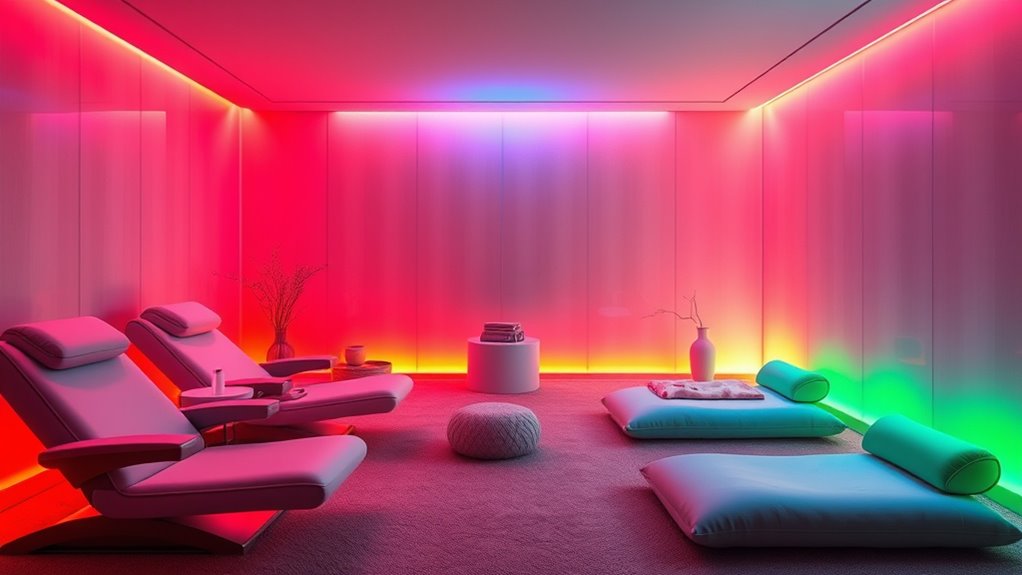
Chromotherapy, also known as color therapy, has gained popularity in wellness spaces for its ability to influence mood and promote healing. As you explore this practice, it’s helpful to understand its historical origins and what scientific evidence supports or challenges its claims. Historically, chromotherapy dates back thousands of years, with roots in ancient Egypt, China, and India. These cultures believed that colors could affect the body’s energy and balance, using colored lights, fabrics, and visualizations as part of healing rituals. In the 19th century, the concept gained more formalized attention through figures like Edwin Babbitt, who proposed that different colors corresponded to specific physiological and emotional states. Over time, this idea evolved into a form of alternative medicine, with practitioners claiming that specific colors could target ailments, improve mental health, or boost overall well-being.
Despite its long history, scientific evidence supporting chromotherapy remains limited and often inconclusive. Numerous studies have attempted to validate these claims, but many suffer from methodological flaws such as small sample sizes, lack of controls, or subjective outcome measures. Some small-scale experiments suggest that exposure to certain colors might influence mood temporarily—blue lighting, for instance, can promote calmness, while red may increase alertness. However, these effects are generally short-lived and don’t establish a direct, reliable link between color exposure and long-term health benefits. The mainstream scientific community considers chromotherapy to be a pseudoscience because it lacks robust empirical support and doesn’t adhere to the rigorous standards of evidence-based medicine.
That said, some researchers recognize that colors do have psychological effects, but they argue that these effects are highly context-dependent and influenced by individual associations and cultural background. For example, a person’s personal experience with a color might shape how they respond to it, making the practice more subjective than objective. Additionally, recent advances in nanotechnology have explored how precise manipulation of light and color at the microscopic level could someday enhance therapeutic outcomes, although these are still largely experimental. As a result, while chromotherapy can be used as a complementary tool to enhance relaxation or mood in some cases, it shouldn’t replace proven medical treatments. When you encounter claims about color therapy curing diseases or replacing conventional medicine, it’s wise to approach them with skepticism. Ultimately, understanding its historical roots helps appreciate its cultural significance, but scientific evidence remains insufficient to fully endorse chromotherapy as a reliable medical or psychological intervention.

7 in 1 Portable Light Therapy for Face for Body Lamp with Stand, 920nm Red Infrared Light Therapy Device, LED Face Skin Body Skin Care at Home
- Multiple Light Colors and Functions: 7 colors and 7 treatment modes
- Portable and User-Friendly Design: Compact, lightweight, with large battery
- Full Body Light Therapy: Treats face, skin, muscles, and joints
As an affiliate, we earn on qualifying purchases.
As an affiliate, we earn on qualifying purchases.
Frequently Asked Questions
How Does Chromotherapy Compare to Traditional Medical Treatments?
You’ll find that chromotherapy often relies on color psychology and the placebo effect, making it quite different from traditional medical treatments. While medical treatments are evidence-based and target specific conditions, chromotherapy mainly aims to influence mood and well-being through colors, which may or may not have proven effects. It’s best used as a complementary approach, not a substitute for proven medical therapies.
Are There Any Risks Linked to Chromotherapy Sessions?
There are minimal physical risks linked to chromotherapy sessions, but you should be aware of potential placebo effects that might influence your perception of benefits. Since many practices are unregulated, it’s possible to encounter unqualified practitioners or inconsistent treatments. Always research providers carefully, and remember that chromotherapy shouldn’t replace conventional medical advice. While generally safe, approach it as a complementary therapy, understanding its limitations and the importance of professional oversight.
What Scientific Studies Support Chromotherapy’s Effectiveness?
Scientific studies on chromotherapy’s effectiveness are limited, but some support its connection to color psychology and light therapy. You might notice that certain colors, like blue or green, can promote relaxation, while bright reds energize you. Light therapy, used for conditions like seasonal affective disorder, shows how specific wavelengths impact mood. However, more rigorous research is needed to fully confirm chromotherapy’s benefits beyond these established practices.
Can Chromotherapy Be Integrated With Conventional Healthcare?
You might think conventional healthcare would dismiss holistic healing, but you can actually integrate chromotherapy with it using color therapy techniques. While some skeptics scoff at this blend, many practitioners believe it enhances patient well-being. By combining evidence-based treatments with holistic approaches, you create a more all-encompassing care plan. So, yes, integrating chromotherapy isn’t just possible; it can enrich conventional healthcare, offering a unique, colorful dimension to healing.
How Do I Identify Reputable Chromotherapy Practitioners?
To identify reputable chromotherapy practitioners, start by verifying their credentials through official licensing boards or professional associations. Look for practitioners who customize treatments based on your individual needs rather than offering generic solutions. A trustworthy practitioner will openly discuss the science behind chromotherapy, ensure transparent communication, and tailor sessions specifically for you. Avoid those who make exaggerated claims or lack proper certification, guaranteeing your safety and the effectiveness of your treatment.
Conclusion
As you explore chromotherapy in wellness spaces, remember that science lights the way, guiding you through the colorful maze. While some hues might seem like magic, it’s essential to distinguish between genuine evidence and pseudoscience. Think of science as your trusty compass—helping you navigate safely through the spectrum of claims. Don’t let the allure of vibrant colors blind you; instead, let reason be your steady lighthouse in the sea of wellness trends.