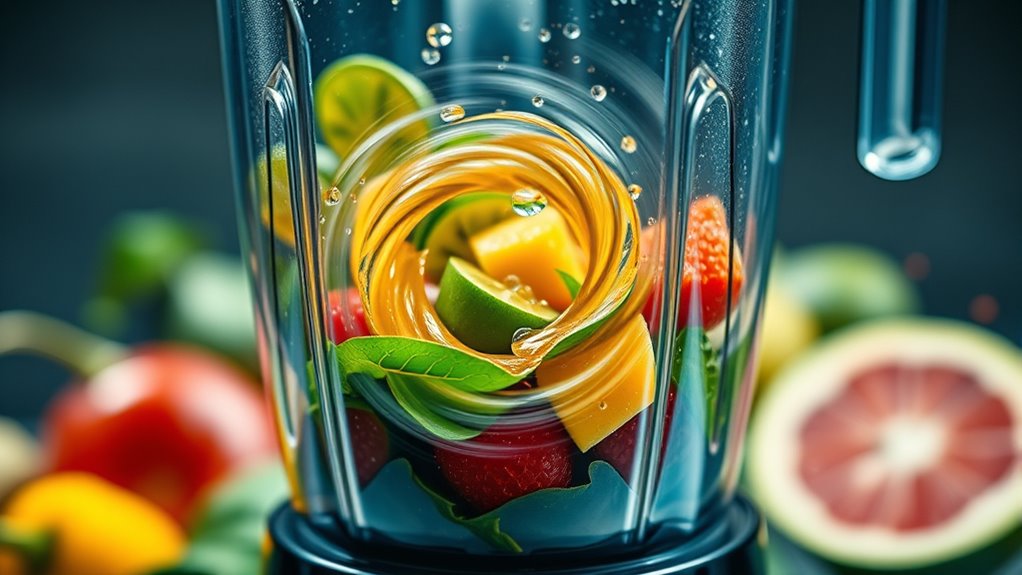

In a blender, physics principles like shear forces, fluid dynamics, and rotational energy work together to cut, vortex, and mix ingredients. When you turn it on, the blades spin rapidly, creating powerful shear forces that break down solids. The vortex forms as the liquid spins in a rotating column, drawing ingredients toward the blades for even mixing. Faster speeds generate stronger vortexes and shear, enhancing blending. Keep exploring to understand how these forces optimize your blending results.
Key Takeaways
- Blade design and sharpness create shear forces that break down ingredients, enhancing cutting efficiency.
- Rapid blade rotation generates kinetic energy, increasing shear forces and turbulence for effective blending.
- Vortex formation results from fluid dynamics, drawing ingredients toward blades for thorough mixing and ingredient breakdown.
- Speed settings control rotational velocity, influencing vortex strength and ability to process tougher ingredients.
- Fluid flow and vortex dynamics optimize blending by ensuring even circulation and preventing unmixed pockets.
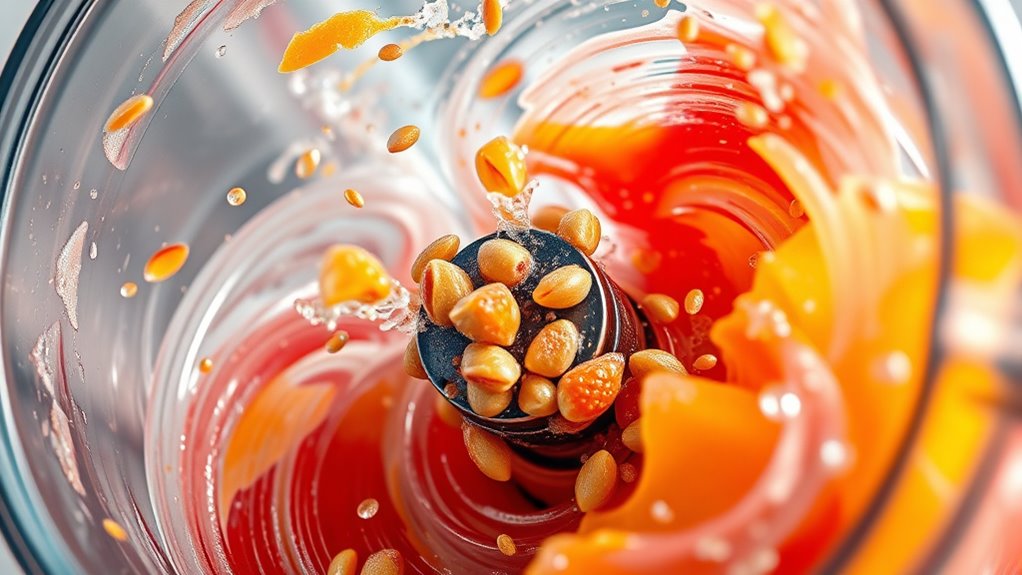
Blenders are fascinating examples of applied physics, combining principles of mechanics, fluid dynamics, and energy transfer to turn solid ingredients into smooth mixtures. When you operate a blender, the blades spin rapidly, and their design plays a vital role in how effectively they process ingredients. The blade design isn’t just about sharpness; it involves angles, curvature, and the number of blades, all engineered to optimize cutting, chopping, and blending. Well-designed blades create efficient shear forces that break down solids into smaller particles. They also contribute to the formation of a vortex—a powerful, rotating column of mixture that pulls ingredients toward the blades. This vortex formation ensures that all ingredients are circulated evenly, preventing pockets of unmixed solids or liquids and allowing for a consistent, smooth blend.
As the blades spin faster, they generate more kinetic energy, which translates into greater shear forces and turbulence within the container. The vortex acts as a conduit for this energy, drawing ingredients downward and inward, so they are repeatedly subjected to cutting and blending forces. This process is a direct application of fluid dynamics principles, where the flow behavior of liquids is influenced by the shape and movement of the blades. The vortex not only improves mixing efficiency but also helps in breaking down fibrous or tough ingredients, making your smoothies or purees smoother and more uniform. Additionally, the material and construction of the blades can influence durability and performance over time.
Speed settings on your blender control the rotational velocity of the blades, directly impacting the physics at play. Higher speeds increase the energy transferred to the ingredients, intensifying shear forces and vortex strength. This allows you to handle tougher ingredients or achieve finer textures. Conversely, lower speeds are suitable for gentle mixing or stirring without overprocessing delicate ingredients. The relationship between speed, blade design, and vortex formation illustrates how energy transfer and fluid motion come together to produce the desired blending outcome.
In essence, the physics behind blenders reveals a finely tuned system where blade geometry and rotation speed orchestrate fluid flow, vortex formation, and ingredient breakdown. You can think of your blender as a dynamic machine that harnesses these physical principles to deliver perfectly blended results. Understanding these factors helps you appreciate the engineering behind your kitchen device and empowers you to choose the right settings and blender design for different tasks. Whether you’re making a smoothie or pureeing vegetables, the physics at work ensures your ingredients are transformed efficiently by the clever interplay of blade design, vortex formation, and energy transfer. Recognizing the role of fluid dynamics can enhance your understanding of how different blender designs impact performance.
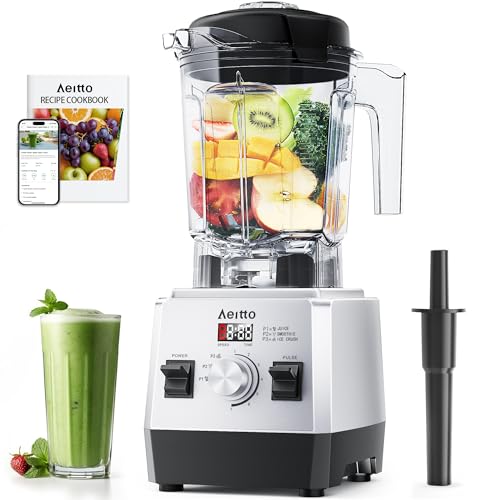
Aeitto Blenders for Kitchen with 68Oz. Large Capacity, 1800W Max Power Smoothie Blender, 3 Preset Programs & 7 Speeds, Professional Countertop Blender for Smoothies, Ice Crush, Silver
- High Power Motor: 1800W peak power for fast blending
- Large BPA-Free Jar: 68oz capacity, food-safe materials
- Preset Programs & Speed: 3 preset modes, 7 adjustable speeds
As an affiliate, we earn on qualifying purchases.
As an affiliate, we earn on qualifying purchases.
Frequently Asked Questions
How Do Blade Angles Affect Blending Efficiency?
You’ll find that blade angles markedly impact blending efficiency through blade design, influencing blending dynamics. When blades are angled correctly, they create a strong vortex that pulls ingredients toward the center, ensuring thorough mixing. Steeper angles increase cutting power, but too steep can cause splattering. Properly optimized blade angles balance cutting and vortexing, making your blender more effective at breaking down ingredients quickly and smoothly, saving time and effort.
What Materials Best Withstand High-Speed Vortexing?
Your blender’s vortexing can feel like a tornado, so you need materials that can handle the chaos. Metal alloys like stainless steel and titanium excel because of their incredible durability and heat resistance, making them perfect for high-speed blending. These materials withstand intense vibrations and heat, ensuring your blender stays intact and efficient. Choose wisely, and your blender will perform like a superhero, tackling anything you throw its way!
How Does Fluid Viscosity Influence Vortex Formation?
Fluid viscosity impacts vortex formation considerably; higher viscosity tends to hinder vortex stability, making it harder for a stable vortex to develop. Conversely, low-viscosity fluids allow easier vortex formation and maintain stability at high speeds. When you blend thick liquids, expect less pronounced vortexing, while thinner liquids produce more stable, visible vortices. Adjust your blender’s speed accordingly to optimize vortex stability based on fluid viscosity.
Can Blender Physics Be Applied to Industrial Mixing?
Think of your blender as a tiny power plant, where rotor dynamics create a swirling vortex in the mixing chamber. Yes, blender physics directly apply to industrial mixing, helping optimize efficiency and uniformity. By understanding how rotor speed and chamber design influence flow, you can improve large-scale processes. This knowledge guarantees your industrial mixers operate smoothly, much like your blender, but on a far grander, more powerful scale.
What Are the Safety Mechanisms Related to Blender Physics?
You should always guarantee safety mechanisms like safety switches and lid locks are in place when using a blender. Safety switches automatically turn off the motor if the blender is not properly assembled, preventing accidents. Lid locks keep the lid secure during operation, avoiding splashes or injuries. Never bypass these features, and regularly check their functionality to maintain safe use, especially when blending at high speeds or handling tough ingredients.
Conclusion
Now that you understand how blenders work, you see them as more than just kitchen gadgets—they’re like tiny storms swirling and slicing with purpose. Every turn of the blade harnesses powerful physics, transforming ingredients into smooth perfection. So, next time you blend, remember you’re orchestrating a mini symphony of forces. It’s amazing how such a simple device can *unleash* a whirlwind of science, turning ordinary food into extraordinary nourishment.