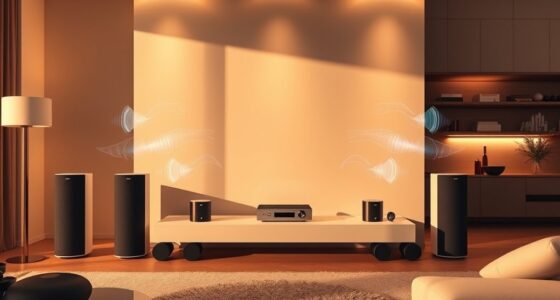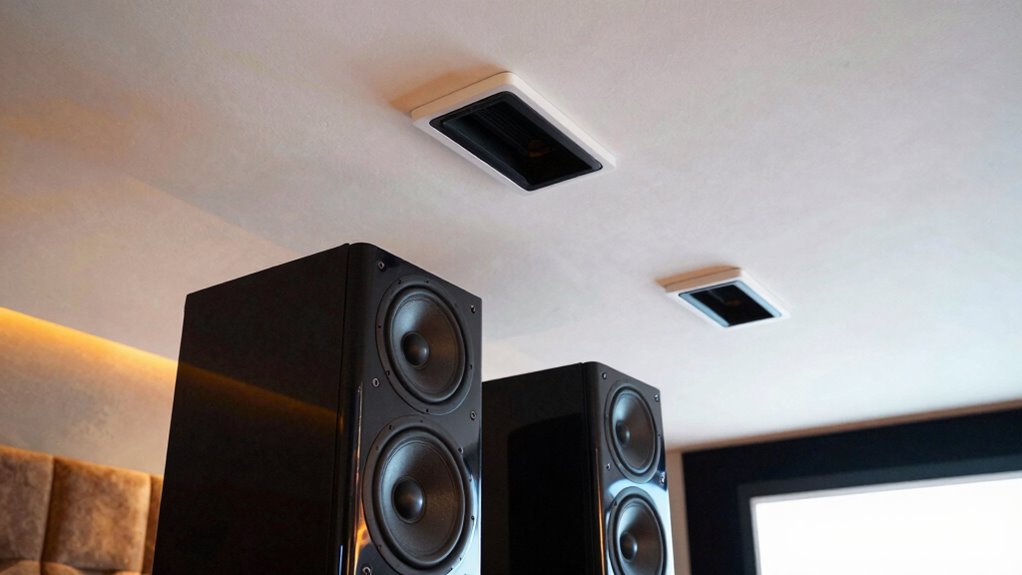
Dolby Atmos offers immersive sound by adding overhead effects, and choosing between upfiring and in-ceiling speakers impacts how well you experience this. Upfiring speakers are easier to install since they bounce sound off the ceiling, creating overhead effects without ceiling modifications. In-ceiling speakers are embedded directly into the ceiling for precise placement and clearer overhead sounds. Understanding the benefits of each helps you optimize your setup, and if you keep exploring, you’ll discover how to make your Atmos system truly immersive.
Key Takeaways
- Upfiring speakers bounce sound off the ceiling to simulate overhead effects, ideal for easy installation.
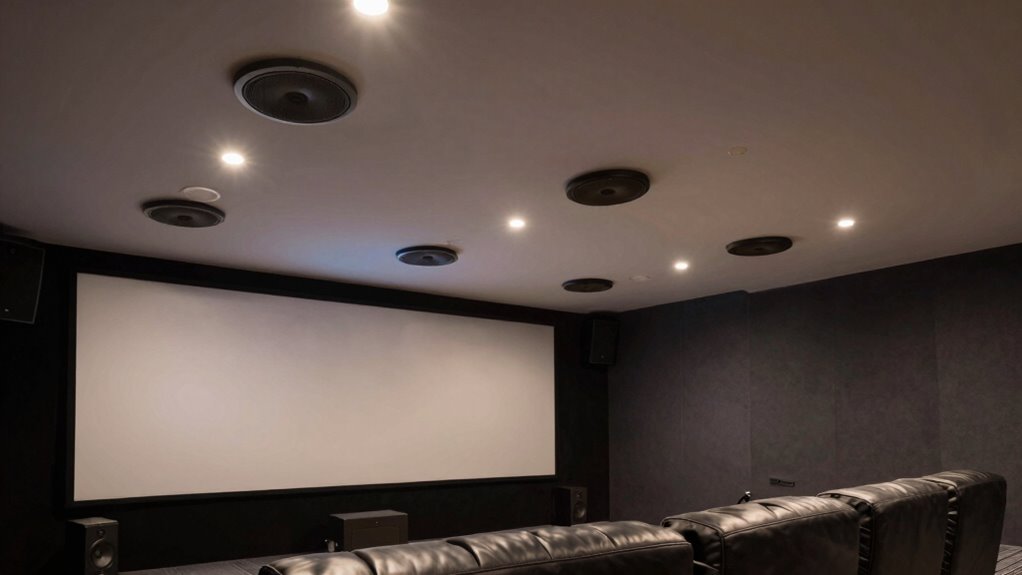
- In-ceiling speakers are embedded into the ceiling, offering precise and seamless sound placement above the listener.
- Proper positioning of both speaker types enhances the immersive three-dimensional Dolby Atmos experience.
- Upfiring speakers are more flexible but depend on ceiling height and acoustics for effectiveness.
- In-ceiling speakers provide consistent overhead sound, often delivering a more accurate atmospheric effect.
Have you ever wondered how some movies and music seem to surround you with sound from every direction? That’s the magic of Dolby Atmos, a revolutionary sound technology that creates a truly immersive experience. To achieve this, the placement of speakers plays a vital role. Proper speaker placement means positioning your upfiring or in-ceiling speakers correctly, so they reflect sound off the ceiling in a way that mimics a three-dimensional space. When done right, it feels like sound is coming from above, around, and even behind you, making every scene more realistic. But even with the best placement, your system won’t perform at its peak without sound calibration. Calibration adjusts the speaker levels, distances, and angles, ensuring each sound is balanced and correctly positioned in the virtual space. Think of calibration as fine-tuning your setup so that all elements blend seamlessly, giving you the most authentic experience possible.
When it comes to speaker placement, upfiring speakers are designed to sit on your furniture or stand on shelves, bouncing sound off the ceiling to create overhead effects. These are usually easier to install in rooms where you can’t mount speakers into the ceiling. On the other hand, in-ceiling speakers are built into the ceiling itself, offering a more seamless look and often more precise sound placement. Whichever option you choose, the key is making sure they’re positioned to maximize the reflection or direct sound paths. For upfiring speakers, you want to place them at ear level or slightly angled towards the listening area. For in-ceiling speakers, placement should be centered above the seating area, with equal distance from the listening position for balanced sound. Proper speaker placement also involves considering room acoustics, which can significantly impact sound quality and immersion.
Sound calibration then ensures all these speakers work in harmony. During calibration, your receiver analyzes the room’s acoustics and adjusts the output levels, delays, and tone to compensate for any room irregularities. This step is essential because even the best placement can be undermined by room reflections, furniture, or other acoustical factors. Many modern receivers come with automatic calibration tools that make this process straightforward—just follow the prompts, and the system will handle the rest. Proper speaker placement combined with meticulous sound calibration transforms your space into a dynamic sound environment. It’s the difference between hearing sounds as just part of the background and feeling as if they’re coming from all around you, heightening your overall experience with Dolby Atmos.

Klipsch RP-500SA Dolby Atmos Surround Sound Speakers (Ebony) (1066507)
1” titanium lts vented tweeters with hybrid tractrix horns
As an affiliate, we earn on qualifying purchases.
As an affiliate, we earn on qualifying purchases.
Frequently Asked Questions
Can Dolby Atmos Be Experienced Without a Dedicated Home Theater System?
Yes, you can experience Dolby Atmos without a dedicated home theater system. Proper speaker placement and room acoustics are key. Use a soundbar with upward-firing or in-ceiling speakers to create a sense of height. Make certain your room’s layout minimizes sound reflections and optimizes speaker positioning. While a full Atmos setup offers the best experience, even simpler configurations with good speaker placement and acoustics can deliver impressive, immersive sound.
What Are the Cost Differences Between Upfiring and In-Ceiling Speakers?
Imagine your home theater as a symphony, with speakers as the instruments. Upfiring speakers usually cost less upfront, like affordable percussion, but may need extra wiring and mounting, driving up installation costs. In-ceiling speakers are often pricier—think of them as the grand violin—yet they blend seamlessly, reducing installation complexity. Your choice depends on your budget and how much you’re willing to invest in the immersive experience.
How Does Room Size Affect Dolby Atmos Sound Quality?
Room size markedly impacts your Dolby Atmos sound quality. In larger rooms, you need careful speaker placement and better room acoustics to guarantee immersive audio. Bigger spaces can cause sound to disperse, reducing clarity, so you might consider additional speakers or acoustic treatments. Smaller rooms tend to focus sound better, but poor placement still hampers experience. Adjust your setup based on room size, optimizing speaker placement and improving room acoustics for the best Atmos effect.
Are There Compatibility Issues With Existing Home Audio Equipment?
You might face compatibility challenges when integrating Dolby Atmos into your existing home audio setup. Some older equipment may not support the latest audio formats or require additional hardware like an AV receiver upgrade. To enjoy seamless equipment integration, check your gear’s specifications and make sure it’s Atmos-compatible. Upgrading components or adding compatible speakers can resolve issues, giving you an immersive sound experience without compatibility headaches.
What Maintenance Is Required for Dolby Atmos Speaker Setups?
You’ll want to regularly check your Dolby Atmos speakers to guarantee ideal performance. Perform speaker calibration to balance sound levels and angles, making sure everything’s aligned correctly. Additionally, consider acoustic treatment in your room—like adding rugs, curtains, or diffusers—to reduce reflections and improve sound clarity. Keep the connections secure and dust-free, and periodically inspect for damage. Proper maintenance guarantees immersive, high-quality sound from your Atmos setup.

Klipsch CDT-5800-C II In-Ceiling Speaker – White (Each)
1” Titanium Tweeter
As an affiliate, we earn on qualifying purchases.
As an affiliate, we earn on qualifying purchases.
Conclusion
Now you know the difference between upfiring and in-ceiling speakers for Dolby Atmos. While some believe upfiring speakers can’t match true in-ceiling sound, many find they deliver a surprisingly immersive experience at a lower cost. The truth is, both can work well depending on your room and preferences. So, don’t just rely on myths—try both options if you can and see which truly elevates your home theater experience.

Acoustic Research 8" Speaker Foam Surround Edge Repair Kit – 2 Speaker Kit – Fits Acoustic Research AR 4, 6, 7, 8, 8E, AR9 (mid), 10, 15, 16, 17, AR18, AR18B, 20, 25, 35, 90, 93, 94, 162, Many More
As an affiliate, we earn on qualifying purchases.
As an affiliate, we earn on qualifying purchases.

ULTIMEA 7.1ch Dolby Atmos Surround Sound System for TV, with 4 Surround Speakers, Surround Sound System Sound Bar with Subwoofer for Home Theater, App Control, HDMI eARC, Aura A60, 2026 Model
Dolby Atmos Delivers an Immersive 3D Soundscape: This 7.1ch dolby atmos soundbar enhances your listening experience with multidimensional…
As an affiliate, we earn on qualifying purchases.
As an affiliate, we earn on qualifying purchases.