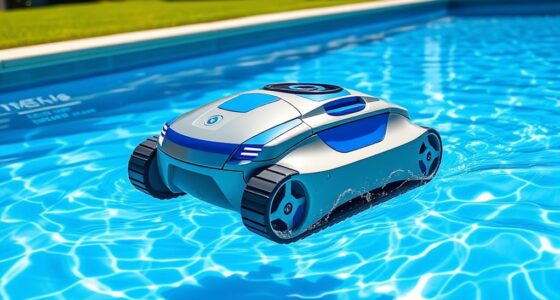
Suction pool cleaners attach directly to your pool’s skimmer or suction port and use your existing pump to vacuum debris, making them simple and easy to operate. Pressure cleaners connect to a dedicated booster pump and generate their own water pressure for movement and cleaning. While suction models are generally less complex, pressure cleaners can cover larger areas faster. To discover the key differences and find the best fit for your pool, keep exploring the options.

Get decor and gifts delivered free with Prime
- Fast, free delivery on millions of items
- Prime Video, Amazon Music and more included
- Member-only deals all year
Key Takeaways
- Suction cleaners attach to the skimmer and use pool pump suction, while pressure cleaners connect to a dedicated pressure port and use pressurized water.
- Suction cleaners generally operate more simply with fewer parts, whereas pressure cleaners have more moving components for enhanced maneuverability.
- Pressure cleaners typically clean faster and more thoroughly in complex or debris-heavy pools compared to suction cleaners.
- Suction cleaners are more cost-effective and easier to maintain, but may be less effective in intricate pool shapes or heavy debris.
- Technological upgrades can improve both types, but pressure cleaners often offer better coverage and efficiency in challenging pool conditions.

Suction pool cleaners operate by attaching to your skimmer or dedicated suction port. They rely on the pool’s existing pump to generate the vacuum needed to move around and pick up debris. Because they use the pool’s filtration system, they tend to be simple and straightforward, often requiring less setup. However, their robotic efficiency can be somewhat limited, especially in pools with complex shapes or lots of debris. They typically follow a random or programmed path, which might leave some areas untouched, and their cleaning speed can be slower compared to pressure cleaners. When it comes to maintenance requirements, suction cleaners are generally easier to maintain—they have fewer moving parts, and their parts are simple to access and clean. Regularly checking the hoses and brushes, replacing worn parts, and ensuring the suction lines are clear usually suffices to keep them running smoothly. Additionally, since they depend on the pool’s existing pump, their effectiveness can be influenced by the pump’s power and condition. Moreover, their efficiency can be improved by ensuring proper pool maintenance and regular system checks to optimize suction performance. Incorporating advanced technology can also enhance their cleaning capabilities and coverage, making them more effective over time. Proper hose setup and positioning can further maximize their debris pickup and overall efficiency.
Products Worth Considering

Dyson V12 Detect Slim Absolute Cordless Stick Vacuum

Sonos Arc Ultra Soundbar with Dolby Atmos, Black

Roborock Q7 M5+ Robot Vacuum and Mop with Self-Emptying Dock
As an affiliate, we earn on qualifying purchases.
Frequently Asked Questions
Which Cleaner Is More Energy-Efficient for Long-Term Use?
You’re wondering which cleaner saves more energy over time. Generally, suction pool cleaners are more energy-efficient because they use less power, leading to lower energy consumption. This results in better long-term savings on your electricity bill. Pressure cleaners tend to consume more energy due to their pump requirements. So, for ongoing energy efficiency and cost savings, a suction cleaner usually makes the better choice.
Can Suction and Pressure Cleaners Be Used Together?
It’s a coincidence that some pool owners wonder if they can use suction and pressure cleaners together. The answer is yes—you can combine operation for hybrid cleaning to maximize efficiency. Using both cleaners in tandem helps cover all pool surfaces more thoroughly, saving you time and effort. Just confirm your equipment is compatible and follow manufacturer guidelines for safe, effective combined operation, giving your pool the best clean possible.
How Do Maintenance Costs Compare Between the Two Types?
When comparing maintenance costs, you’ll find pressure pool cleaners often have a higher cost comparison due to more complex parts that can wear out faster, leading to increased repair frequency. Suction cleaners tend to be simpler, so they usually cost less to maintain and repair. You should consider how often repairs are needed and the overall durability of each type to decide which fits your budget better over time.
Are There Specific Pool Sizes Better Suited for Each Cleaner?
Did you know that 60% of pool owners find pressure cleaners ideal for larger pools? When it comes to pool size, suction cleaners work best for small to medium pools, offering efficient cleaning without extra power. Conversely, pressure cleaners excel in bigger pools because they cover more area quickly. So, if you’re managing a large pool, pressure cleaners are typically more suitable, while suction units suit smaller setups better.
Do These Cleaners Work Effectively on All Pool Surfaces?
You might wonder if these cleaners work on all pool surfaces. Generally, their effectiveness depends on pool surface compatibility; suction cleaners are gentle on delicate surfaces like vinyl, while pressure cleaners excel on rougher surfaces like concrete. To guarantee ideal cleaner effectiveness, check the manufacturer’s recommendations. Keep in mind that some cleaners are better suited for specific surfaces, so choosing the right one helps maintain your pool’s condition and cleanliness effectively.
Conclusion
Choosing between suction and pressure pool cleaners is like picking the perfect dance partner; each has its rhythm and style. Suction cleaners glide smoothly along your pool’s floor, while pressure cleaners tackle stubborn dirt with a powerful push. Think of it as finding your pool’s perfect rhythm—whether you prefer gentle elegance or vigorous action. Whichever you choose, your pool will sparkle like a diamond, ready for your next swim adventure. Plunge in confidently and let your cleaner do the heavy lifting!