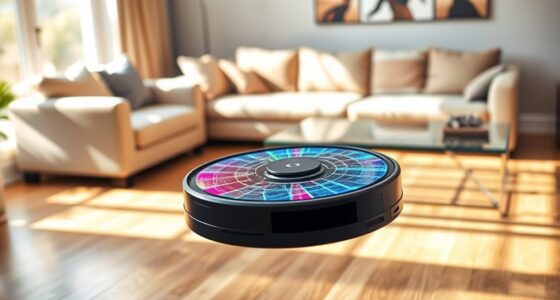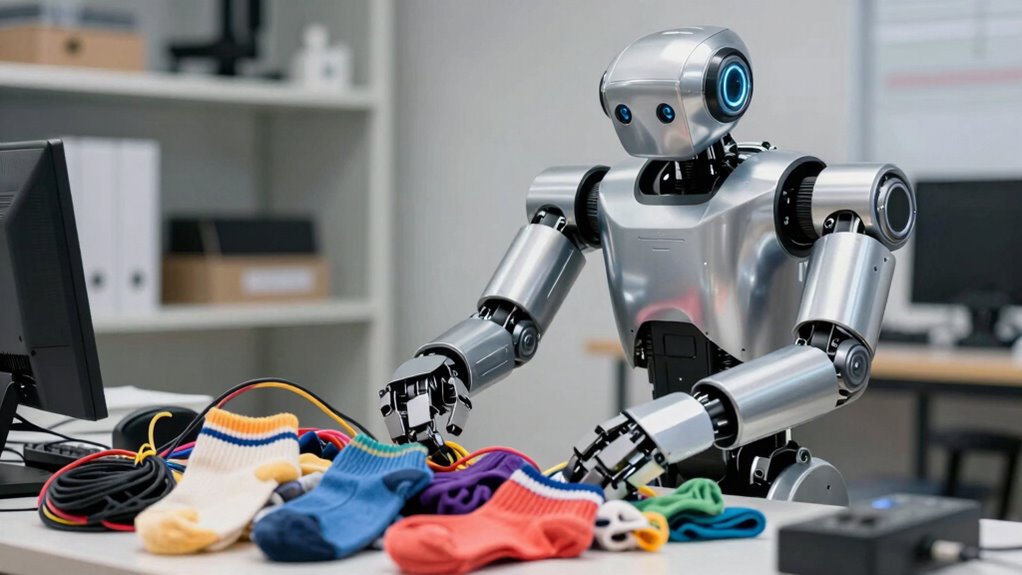
Robots don’t see socks and cables by magic—they rely on precise sensor calibration and advanced mapping techniques. Properly calibrated sensors like lidar and ultrasonic give accurate measurements, preventing false alarms or missed obstacles. They turn raw data into detailed obstacle maps, helping the robot understand its surroundings and avoid hazards effectively. If you want to discover how these processes work together to improve robot navigation, keep exploring further.
Key Takeaways
- Precise sensor calibration ensures accurate detection of small or transparent objects like socks and cables.
- Obstacle mapping translates sensor data into real-time spatial representations for effective avoidance.
- Proper data processing differentiates between harmless items and hazards, improving navigation safety.
- Sensor calibration minimizes false positives and missed obstacles, enabling reliable object detection.
- Combining calibration with advanced mapping enhances a robot’s ability to see and avoid complex, cluttered environments.
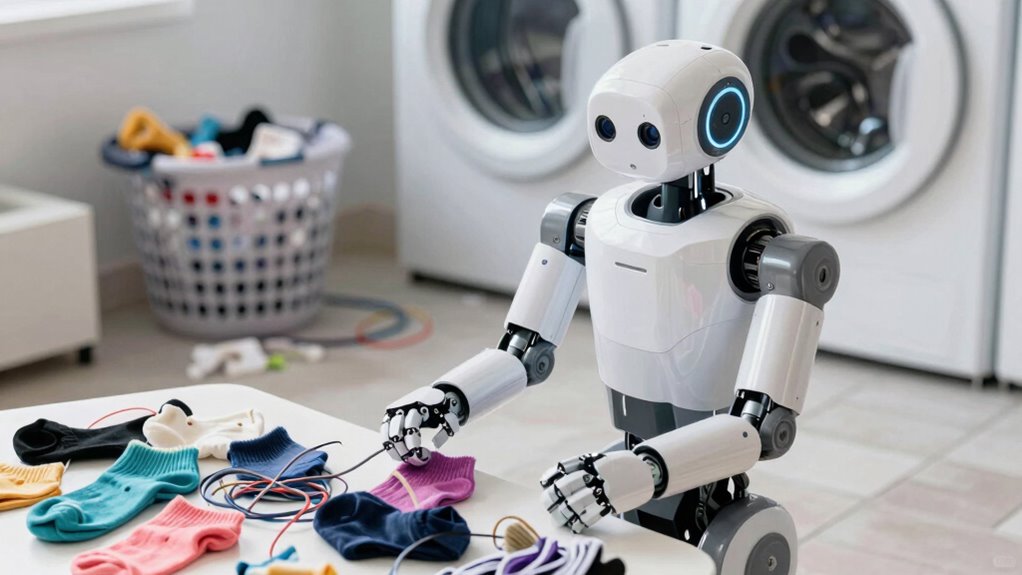
Object avoidance is a vital aspect of robotic navigation that enables robots to move safely and efficiently through their environment. To achieve this, robots rely heavily on sensors that detect obstacles like socks, cables, or furniture. But simply having sensors isn’t enough; they must be properly calibrated to ensure accurate readings. Sensor calibration involves fine-tuning the sensors so that their measurements reflect real-world distances precisely. Without calibration, a robot might mistake a sock for a wide-open space or overlook a thin cable, risking collisions. When sensors are calibrated correctly, they produce reliable data that forms the foundation of obstacle mapping—the process of creating a mental map of obstacles in the robot’s surroundings. Obstacle mapping is critical because it helps the robot understand where objects are located and how to navigate around them. This process involves collecting data from sensors, then translating that data into a spatial representation that the robot can interpret. For example, if your robot uses lidar or ultrasonic sensors, the data will be processed into a point cloud or a grid map highlighting obstacles. These maps are dynamic, updating as the robot moves and encounters new objects, allowing continuous adjustment of its path. By combining sensor calibration with obstacle mapping, your robot can distinguish between a harmless sock on the floor and a potentially hazardous cable that could entangle or damage it. The accuracy of this system depends on how well the sensors are calibrated, as miscalibration can lead to false positives or missed obstacles. This is especially important when dealing with small or transparent objects that are harder to detect. Once the obstacle map is created, the robot’s navigation algorithms use it to plan safe routes, avoiding hazards while maintaining efficiency. The better the obstacle map, the smoother and more reliable the robot’s movement. You might think of it as giving your robot a clear set of eyes and a detailed mental map, allowing it to ‘see’ socks and cables and understand how to move around them without hesitation. Proper sensor calibration plays a crucial role here because it ensures the obstacle maps are accurate, enabling your robot to make quick, confident decisions. Additionally, understanding the contrast ratio of sensors can further improve obstacle detection accuracy in varying lighting conditions. In essence, object avoidance isn’t magic; it’s a combination of precise sensor calibration and intelligent obstacle mapping that makes robots capable of navigating complex, cluttered environments with confidence and safety.
Frequently Asked Questions
How Do Robots Differentiate Between Similar Objects Like Socks and Cables?
You can understand how robots differentiate between socks and cables through visual recognition and pattern matching. They analyze images from cameras, identifying unique shapes, textures, and colors. Pattern matching compares these features to stored data of known objects, helping the robot distinguish one from another. This process allows robots to accurately identify and handle similar objects, ensuring efficient sorting and manipulation without confusion.
What Sensors Are Most Effective for Object Detection in Cluttered Environments?
You might think LIDAR and depth cameras are the best sensors for cluttered environments, and they often are. These sensors, when properly calibrated, provide accurate spatial data that helps robots distinguish objects amidst chaos. However, if not calibrated correctly, they can produce false positives, causing misidentification. Combining multiple sensors—like ultrasonic sensors with vision—improves detection and reduces errors, making object detection more reliable in complex, cluttered spaces.
Can Object Avoidance Algorithms Adapt to New or Unexpected Objects?
Yes, object avoidance algorithms can adapt to new or unexpected objects through adaptive learning. You’ll want your robot to continuously analyze sensor data, identify errors, and correct its responses accordingly. This process helps the system learn from real-world experiences, improving detection and navigation around unfamiliar obstacles. Over time, error correction enables your robot to handle diverse, unpredictable environments more reliably, making it more effective in avoiding unexpected objects.
How Do Lighting Conditions Affect a Robot’s Ability to See Objects Clearly?
Ironically, good lighting isn’t always enough to help your robot see clearly. Ambient lighting can confuse its sensors, especially when shadows cast by objects create illusions or hide hazards. Too much sunlight or uneven illumination can distort how it perceives obstacles, making shadow effects a real challenge. So, in dim or overly bright conditions, your robot’s vision might falter, proving that even high-tech sensors struggle without proper lighting.
What Are the Limitations of Current Object Detection Technology in Robotics?
You’ll find that current object detection tech faces limitations with sensor accuracy, especially in cluttered or dynamic environments. Processing speed can also hinder performance, causing delays in real-time decisions. These issues mean robots might miss small or fast-moving objects, or struggle with complex scenes. While advancements are improving these areas, achieving perfect detection remains challenging due to sensor and processing constraints.
Conclusion
You might think robot object avoidance is magic, but it’s all about sensors and smart algorithms. Did you know that some robots can detect objects as small as 1 millimeter? That’s like spotting a tiny sock or cable in a cluttered room! With advancements in computer vision, you’re closer than ever to having robots seamlessly navigate complex environments. It’s not magic—it’s tech making your life easier, one sock at a time.