
TL;DR

Get decor and gifts delivered free — and shop member deals
- Fast, free delivery on millions of items
- Access to Prime Big Deal Days deals on October 6–7
- Prime Video, Amazon Music and more included
A Hunker home-design report describes using concrete breeze blocks to create privacy in a yard without making a patio feel closed off from airflow and light. The blocks can form a partial screen or wall, but the report does not address installation requirements, costs, or how much privacy a particular design provides.
Concrete breeze blocks can screen a yard from neighbors while letting air and light pass through, according to a Hunker home-design report on alternatives to solid fencing. The approach may suit patios where homeowners want a visual barrier without the enclosed feel that a solid fence can create.
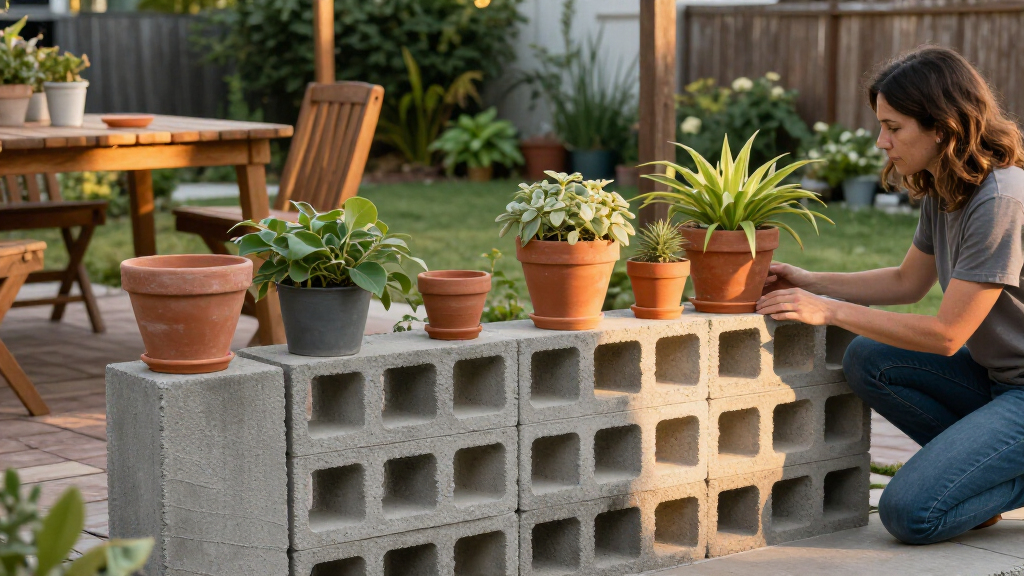
Breeze blocks are concrete masonry units with decorative openings. From a distance, a screen made from them can read as a wall, while the cutouts preserve some visibility, airflow and daylight. Hunker says the blocks are available in a range of patterns and styles, making them both a screening option and a design feature.
The report suggests sourcing patterned blocks from masonry or landscape suppliers. It also points to standard 8-by-8-by-16-inch concrete blocks as a less expensive alternative, arranged with deliberate gaps for a geometric effect. The report advises buyers to check that the blocks have hollow cores; it does not provide a detailed construction guide or a cost comparison.
Placement can vary: blocks may make up a partial dividing wall, be incorporated into a larger patio wall, or stand as a screen. Hunker also suggests painting them or combining them with planters and climbing vines to soften their appearance. These are design ideas, not claims that every layout will provide the same privacy or airflow.
Privacy Without a Solid Barrier
A solid fence can interrupt sightlines and define a yard, but it can also make a small patio feel more enclosed. Breeze blocks offer a middle ground: their openings allow air and light through while breaking up views. That can matter in outdoor spaces where comfort and privacy are both priorities, particularly in warm conditions.
The trade-off is that a perforated screen does not block views in the same way as an opaque fence. How much it conceals depends on the block pattern, wall height, spacing and viewing angle. Homeowners considering the option should treat privacy as a design outcome to test for their specific yard, rather than assume the blocks provide complete screening.
concrete breeze blocks for yard privacy
As an affiliate, we earn on qualifying purchases.
As an affiliate, we earn on qualifying purchases.
A Mid-Century Masonry Feature
The idea of using pierced screens outdoors predates concrete breeze blocks. Hunker traces similar approaches to screens used in Asia to provide shade while allowing air to move through. In the United States, the concrete form gained popularity in the 1930s, alongside Art Deco design; the report also notes that Frank Lloyd Wright experimented with patterned “textile blocks” in the 1920s.
Breeze blocks became especially prominent during the 1950s and 1960s, when they served as both architectural decoration and a practical way to encourage airflow. Hunker says they were popular in hot regions and could also act as windbreaks where outdoor spaces needed shelter. The current report revisits that established building material as an alternative to conventional backyard fencing.
“The cutouts in these concrete blocks allow both air and light to pass through.”
— Hunker report
Privacy Depends on the Layout
The report does not specify how tall a block screen should be, how far apart blocks should sit, or what level of visual privacy different patterns provide. It also supplies no installation instructions, structural guidance, pricing, permit information or durability testing. Those details can vary with the site, product and local requirements.
It is also unclear how much airflow a particular wall would preserve: openings, wall dimensions and the surrounding layout all affect the result. Hunker presents the blocks as a design alternative, but the supplied material does not establish that they will suit every yard or replace a fence where full screening is needed.
Check Products and Site Needs
Homeowners interested in the idea can compare patterned units from masonry or landscape suppliers with standard hollow-core concrete blocks, then assess the intended wall location and the views it needs to screen. A small-scale layout or product sample can help show how a pattern looks from the yard and from neighboring sightlines before a larger project begins.
Before building, readers should seek product-specific installation guidance and check local rules that may apply to walls or outdoor structures. The Hunker report does not announce a construction standard or a follow-up project; further decisions depend on the chosen blocks, the site and the homeowner’s privacy and airflow needs.
Key Questions
What are concrete breeze blocks?
Breeze blocks are concrete blocks with openings or decorative cutouts. Used in a screen or wall, the openings let some light and air through while interrupting views.
Do breeze blocks provide complete privacy?
Not necessarily. The report describes them as a way to screen a yard, but the amount of privacy depends on the block pattern, height, spacing and viewing angle. They are not the same as an opaque fence.
Can standard concrete blocks be used instead?
Hunker says standard 8-by-8-by-16-inch concrete blocks can be arranged with intentional gaps as a lower-cost alternative. It advises checking that the blocks have hollow cores; the report does not offer a full installation guide.
How can a breeze-block screen look less industrial?
The report suggests painting the blocks or pairing them with planters and climbing vines. Those choices can soften the concrete’s appearance, though the final effect depends on the design and setting.
What should homeowners check before building a block screen?
Check the block product’s installation guidance, the site’s needs and any local rules that apply to walls or outdoor structures. The report does not specify structural requirements, permits or a recommended wall height.
Source: rss
Fall Picks
fall essentials
As an affiliate, we earn on qualifying purchases.