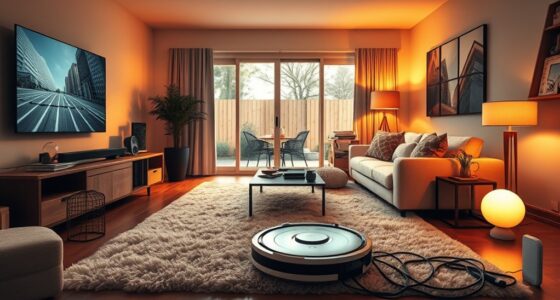
Autonomous home security uses AI-driven threat detection to keep your property safe around the clock. A network of smart sensors, cameras, and environmental monitors work together to gather data and analyze activity in real time. When a potential threat is detected, the system can alert you instantly and trigger automatic responses like locking doors or turning on lights. This proactive approach reduces false alarms and provides peace of mind. Keep exploring to discover how this technology can protect your home more effectively.
Key Takeaways
- Integrates multiple sensors to analyze home activity and identify genuine threats accurately.
- Uses machine learning to adapt and reduce false alarms from harmless movements like pets.
- Provides real-time alerts and automated responses such as locking doors or turning on lights.
- Continuously learns normal patterns to enhance threat detection and system reliability.
- Acts proactively by monitoring multiple angles, deterring intruders, and ensuring constant home security.
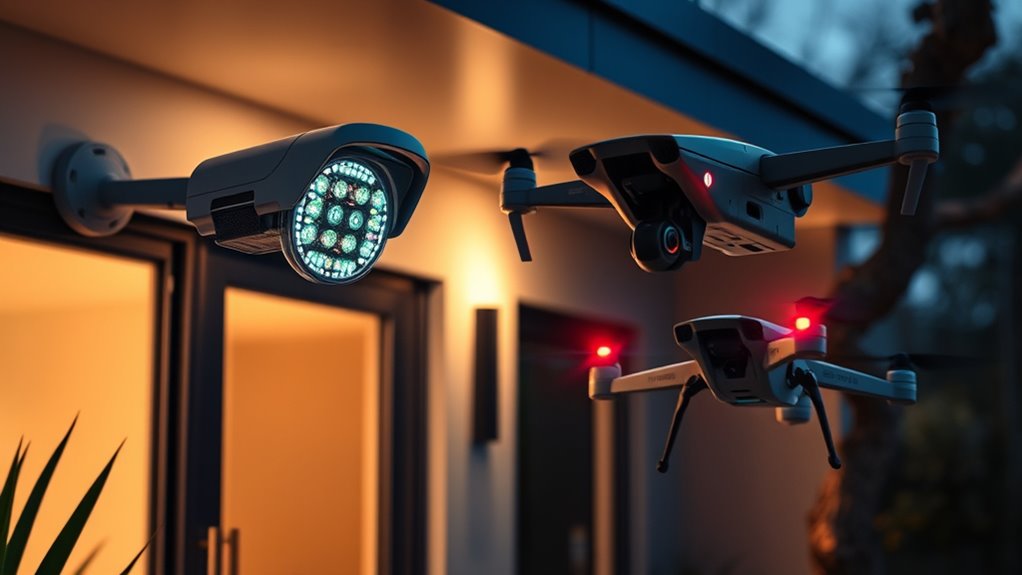
Have you ever wondered how home security is evolving in the age of smart technology? Today’s systems go far beyond traditional locks and alarms, integrating cutting-edge AI to create a truly autonomous environment. One of the key advancements is smart sensor integration, which combines various sensors—motion detectors, door/window sensors, cameras, and environmental monitors—into a cohesive network. This integration allows your security system to gather extensive data points from every corner of your home. Instead of isolated alerts or false alarms, the system analyzes all inputs collectively, providing a more accurate picture of what’s happening. When a sensor detects movement or an unusual change, the system rapidly processes this data, enabling swift decision-making. Developing a comprehensive understanding of your home’s activity patterns enhances the system’s ability to identify genuine threats. Real-time alerting is at the heart of these autonomous security solutions. As soon as the system identifies potential threats, it immediately alerts you via your smartphone, email, or even through smart home devices like voice assistants. This instant communication ensures you’re always in the loop, no matter where you are. Whether it’s an unexpected visitor at your front door or a sudden break-in attempt, real-time alerts empower you to respond promptly. Some systems even include automated responses, such as locking doors, turning on lights, or activating cameras to record the incident, all triggered by the AI’s analysis. This rapid, automated response can deter intruders and help gather vital evidence. The true strength of these systems lies in their ability to learn and adapt. Using machine learning algorithms, they improve over time, better distinguishing between normal activity and genuine threats. For example, if your pet moves around the house, the system recognizes it as harmless, preventing unnecessary alerts. Conversely, if an unfamiliar person loiters near your property at odd hours, the AI raises an alarm. This smart sensor integration combined with real-time alerting creates a seamless security experience, reducing false alarms and increasing reliability. You don’t need to constantly monitor your home; instead, the system acts as your vigilant digital guardian, making decisions and notifying you only when necessary. Ultimately, the evolution of home security into autonomous, AI-driven systems means you gain peace of mind with more precise, faster responses. Smart sensor integration ensures your home is constantly monitored from multiple angles, while real-time alerting keeps you informed instantly. This combination transforms security from reactive to proactive, empowering you to protect your home more effectively than ever before.
Frequently Asked Questions
How Do AI Security Systems Handle False Alarms?
AI security systems handle false alarms by constantly improving alarm accuracy through sensor calibration. They analyze data patterns to distinguish real threats from false triggers, reducing unnecessary alerts. When a false alarm occurs, the system adjusts sensitivity settings and refines its algorithms, making future detections more precise. This adaptive approach guarantees you’re not disturbed by false alarms, providing reliable protection while minimizing disruptions.
What Privacy Measures Protect User Data?
Like a modern-day Minotaur guarding a labyrinth, your data is protected by strict privacy compliance and advanced data encryption. These measures ensure your information stays secure from prying eyes. Your security system only processes data necessary for threat detection, and access is limited to authorized personnel. Rest assured, your privacy remains a top priority, with continuous updates to safeguard your home and personal information against evolving threats.
Can AI Adapt to New Security Threats Automatically?
Yes, AI can adapt to new security threats automatically through machine learning. As new threats emerge, your home security system analyzes patterns and updates its threat adaptation capabilities without manual input. This continuous learning process allows the AI to recognize and respond to evolving threats more effectively, enhancing your safety. You benefit from a smarter, more responsive security system that stays ahead of potential dangers through real-time threat adaptation.
How Does Autonomous Security Compare to Traditional Systems?
You’ll find that autonomous security systems typically offer a better user experience with real-time threat detection and fewer false alarms, unlike traditional systems that rely on manual monitoring. However, integration challenges can arise, especially if your existing setup isn’t compatible. Overall, autonomous systems are more adaptive and efficient, making them a smarter choice for modern home security, provided you address potential integration issues.
What Is the Cost of Implementing Ai-Driven Security?
You’ll find that AI-driven security systems typically cost between $300 and $1,200, depending on features, installation, and brand. A detailed cost analysis helps you understand expenses like sensors, cameras, and ongoing subscriptions. When considering your budget, keep in mind that investing in intelligent detection can reduce false alarms and improve safety, making it a worthwhile addition. Balancing upfront costs with long-term benefits is key to making smart budget considerations.
Conclusion
Imagine trusting AI to protect your home without constant supervision. Some say it’s just a theory, but evidence shows autonomous security systems can detect threats faster and more accurately than humans. As technology advances, it’s clear AI-driven solutions aren’t just a possibility—they’re becoming a reality. Embrace this shift, and you might find your home safer than ever, proving that the idea of fully autonomous security isn’t just science fiction—it’s the future.