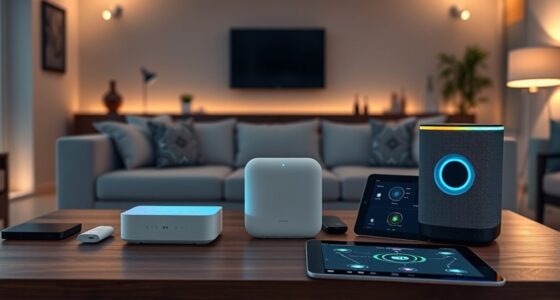
Smart sensors come in various types, including motion detectors, environmental monitors, and industrial sensors, each designed for specific applications like security, climate control, and automation. They collect accurate, real-time data that helps you improve safety, efficiency, and sustainability across sectors such as homes, factories, and agriculture. Proper calibration and seamless integration guarantee these sensors deliver reliable information for smarter decision-making. Keep exploring to discover how these versatile sensors can transform your systems.
Key Takeaways
- Smart sensors include motion detectors, environmental monitors, and biometric devices used across security, healthcare, and environmental management.
- They enable real-time data collection, processing, and integration for automated responses and system optimization.
- Applications range from security systems and industrial automation to environmental monitoring and smart agriculture.
- Proper calibration ensures accurate measurements, enhancing reliability and system effectiveness across various sectors.
- Integration of smart sensors supports intelligent, autonomous systems that improve safety, efficiency, and sustainability.

Smart sensors are revolutionizing the way we interact with technology by providing real-time data and automatic responses. When you work with these sensors, understanding the importance of sensor calibration is essential. Proper calibration ensures that the data collected is accurate and reliable, which is critical for making informed decisions. If a sensor isn’t correctly calibrated, the information it reports could be misleading, leading to errors in automation or analysis. Regular calibration helps you maintain peak performance, especially in environments where conditions change frequently. For example, temperature sensors in weather stations or industrial settings require periodic calibration to account for drift over time. By keeping sensors calibrated, you guarantee that the data you collect remains precise, allowing for better integration with other systems. Additionally, AI-driven automation can analyze sensor data more efficiently, further enhancing system responsiveness.
Data integration is another key aspect when working with smart sensors. These devices don’t operate in isolation; instead, they feed into larger networks that process, analyze, and respond to the information they gather. You’ll find that effective data integration allows different sensors and systems to communicate seamlessly, creating a cohesive ecosystem. This integration is essential in applications like smart homes, where security cameras, motion detectors, and environmental sensors work together to enhance safety and efficiency. It also plays a critical role in industrial automation, where sensor data must be combined with control systems for real-time adjustments. You should focus on establishing standardized data formats and protocols to ensure smooth communication across devices, which simplifies troubleshooting and system upgrades.
Moreover, the versatility of smart sensors extends across various sectors, from security to environmental monitoring. In security systems, sensors detect motion, sound, or even facial features, triggering alarms or notifications instantly. Meanwhile, environmental sensors monitor air quality, humidity, or soil conditions, providing critical insights for agriculture or pollution control. As you deploy these sensors, consider how sensor calibration and data integration work hand-in-hand to maximize their effectiveness. Proper calibration guarantees that the sensor’s output reflects true conditions, while robust data integration ensures this information is efficiently utilized by your control systems or analytics platforms. Together, these elements create intelligent systems capable of proactive responses, reducing human intervention and increasing safety, efficiency, and sustainability.
Frequently Asked Questions
How Do Smart Sensors Differ From Traditional Sensors?
Smart sensors differ from traditional sensors because they actively collect, process, and analyze data on-site, making sensor calibration and data integration easier. Unlike traditional sensors, which just transmit raw data, smart sensors use embedded processors to interpret information, reducing the need for manual calibration and enabling real-time decision-making. This makes them more efficient, versatile, and suitable for complex applications like security systems and environmental monitoring.
What Are the Main Challenges in Deploying Smart Sensors?
You might find deploying smart sensors a bit tricky due to calibration and power management. Ensuring accurate sensor calibration requires ongoing fine-tuning, which can be resource-intensive. Power management poses challenges in maintaining long-term operation, especially in remote locations. These factors demand careful planning and technology integration, but overcoming them leads to more reliable, efficient sensor networks. With patience and proper strategies, you can address these hurdles effectively.
How Secure Are Data Transmitted by Smart Sensors?
You might worry about the security of data transmitted by smart sensors, and it’s valid. Most use data encryption to protect your information during transmission, which enhances security. However, privacy concerns still exist if sensitive data isn’t properly secured or if vulnerabilities are exploited. To stay safe, guarantee your smart sensors have strong encryption protocols and regularly update their firmware to prevent potential breaches.
What Future Advancements Are Expected in Smart Sensor Technology?
The future of smart sensor technology is bright, and you’ll see quantum integration and AI enhancement leading the charge. These advancements will make sensors smarter, faster, and more accurate, allowing seamless data processing and real-time decision-making. As a result, you’ll benefit from improved security, environmental monitoring, and automation. Expect sensors to become more intuitive and adaptive, turning the phrase “the sky’s the limit” into reality for your smart systems.
Are Smart Sensors Cost-Effective for Large-Scale Environmental Monitoring?
Yes, smart sensors are cost-effective for large-scale environmental monitoring. You’ll see significant cost savings through automation and real-time data collection, reducing manual labor and maintenance expenses. Their scalability benefits mean you can expand monitoring networks easily without huge upfront investments. This approach improves accuracy and efficiency, helping you make better-informed decisions while keeping costs manageable over time.
Conclusion
Smart sensors are like the vigilant eyes and ears of our modern world, quietly working behind the scenes to keep us safe, connected, and aware. They weave a web of intelligence through every corner of our environment, turning raw data into valuable insights. As you embrace these tiny yet mighty marvels, remember they’re the silent heroes transforming everyday life into a smarter, safer adventure — guiding us gracefully into a brighter future.