
Finding the best smart home weather station depends on your specific needs, whether you prioritize accuracy, smart home integration, or ease of setup. The Ambient Weather WS-2902 stands out as the overall top choice for its reliable performance and broad compatibility. For those seeking a more budget-friendly option, the AcuRite Iris offers solid features at a lower price. Meanwhile, the Tempest Weather Station appeals to serious weather enthusiasts with its detailed forecasts and app integration. Keep in mind, tradeoffs often involve balancing data accuracy, smart features, and ease of installation. Continue reading for the full breakdown to help you choose the perfect station for your smart home setup.
Key Takeaways
- Accuracy and data reliability vary significantly among models, with professional-grade stations offering the most precise readings.
- Smart home integration is a key differentiator; some stations work seamlessly with voice assistants and smart hubs, others do not.
- Ease of setup and maintenance can influence long-term satisfaction, especially for beginners.
- WiFi connectivity generally provides better remote monitoring and app features than Bluetooth or no wireless options.
- Price ranges broadly, but investing in a higher-quality station often pays off in durability and data quality.




More Details on Our Top Picks
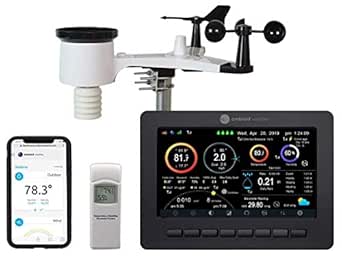
Ambient Weather WS-2902 WiFi Smart Weather Station
This station stands out for its comprehensive hyperlocal data collection, wireless Wi-Fi connectivity, and compatibility with smart home platforms like Alexa, Google Home, and IFTTT. Compared with the Ambient Weather WS-2000, it offers more detailed sensor options and community features, though it involves a slightly more complex setup process. Its data transmission to the Ambient Weather Network and social sharing capabilities make it ideal for weather enthusiasts who want more than just basic info. The main tradeoff is the need for a pole mount and the batteries not being included, which may add to initial setup. Despite those, this station is perfect for dedicated hobbyists or homeowners seeking detailed, customizable weather insights that integrate seamlessly with smart systems.
Pros:- Complete hyperlocal data including wind, UV, solar radiation, and rainfall
- Wireless Wi-Fi transmission supports remote access and community sharing
- Supports both imperial and metric units with calibration options
Cons:- Requires mounting pole and external setup, which may be complex for some users
- Batteries are not included, adding to initial costs
- Setup process can be more involved compared to simpler models
Best for: Homeowners who want hyperlocal, hyper-accurate weather data with smart home integration and community features
Not ideal for: Casual users seeking a simple, plug-and-play weather station without the need for mounting or extensive setup
- Sensor Technology:Wireless multi-sensor array with wind, UV, solar radiation, rainfall
- Connectivity:Wi-Fi enabled, supports IFTT, Alexa, Google Home
- Display:Color LCD display
- Units:Imperial and metric
- Power:Pole mount, batteries not included
- Community Features:Connects to Ambient Weather Network, social feeds
- Calibration:Available for sensor accuracy
- Dimensions:Sensor array includes pole mount
Bottom line: This pick is best for weather enthusiasts and smart home users who value detailed data and community sharing capabilities.
10-in-1 Wireless Weather Station with Outdoor Wireless Sensor, Radio Controlled Clock, Rain Gauge, Wind Speed/Direction, Moon Phase, Barometer, Temperature/Humidity, Weather Forecast (NO WiFi)
This station excels at providing a broad range of environmental data, including wind, rain, barometric pressure, and moon phase, all via wireless sensors. Unlike the Ambient Weather WS-2902, it does not support Wi-Fi but compensates with a 328-ft wireless range and professional-grade sensors, making it suitable for large outdoor spaces or professional research. Its large color LCD display offers detailed real-time data and weather forecasts, though it lacks smart home integration. This model is ideal for users needing reliable, high-precision outdoor data without Wi-Fi dependence, but it’s less suited for users seeking remote access or social sharing features. The main tradeoff is the absence of Wi-Fi, which limits remote monitoring capabilities.
Pros:- High-precision Swiss sensors with professional accuracy
- Long wireless transmission range of 328 ft
- Includes moon phase, weather forecast, and barometric analysis
Cons:- No Wi-Fi support, limiting remote data access
- Requires outdoor sensor placement, which may involve installation effort
- Limited smart home compatibility
Best for: Gardeners or environmental researchers needing precise, wireless outdoor data over long ranges without smart home connectivity
Not ideal for: Smart home enthusiasts or casual users who want remote Wi-Fi access and social features
- Sensor Technology:Wireless outdoor sensors, Swiss precision
- Wireless Range:328 ft
- Display:Large color LCD
- Connectivity:Radio frequency, no Wi-Fi
- Power:Battery operated, 3 AAA batteries included
- Additional Features:Moon phase, weather forecast, barometer
Bottom line: This station makes sense for users who prioritize reliable, long-range wireless outdoor data over smart home features.
Ambient Weather WS-2000 Smart Weather Station with WiFi Remote Monitoring and Alerts
This station offers extensive data collection, including wind, rain, UV, and solar radiation, with a high-definition TFT color display. It surpasses the WS-2902 in data richness and logging capabilities, especially through its web interface and detailed historical charts. While setup is straightforward, the display’s readability off-angle can be an issue, and its barometric pressure arrow is less intuitive than the forecast pictograph. Its Wi-Fi connectivity enables remote monitoring and integration with platforms like Weather Underground, making it a strong choice for weather data enthusiasts who need detailed logs and a sleek interface. The main tradeoff is the size and cost, which might be overkill for casual users seeking basic info.
Pros:- High-definition TFT color display with easy-to-read data
- Supports detailed historical charts and cloud logging
- Wi-Fi connectivity for remote access and Weather Underground integration
Cons:- Display readability off-angle could be better
- Larger size and higher price point
- Limited portability due to external mounting requirements
Best for: Weather hobbyists and homeowners who want detailed data logging and a visual web interface for analysis
Not ideal for: Users seeking a compact, budget-friendly unit or simple on-device display
- Display Type:High-definition TFT color
- Connectivity:Wi-Fi, supports Weather Underground
- Data Points:Wind, rain, UV, solar radiation, historical charts
- Power:5V DC adapter, sensor uses 3 AAA batteries
- Units:Imperial and metric
- Size:Large display console
Bottom line: This station is ideal for dedicated weather enthusiasts wanting comprehensive logging and web visualization tools.
AcuRite Iris (5-in-1) Indoor/Outdoor Wireless Weather Station for Indoor and Outdoor Temperature and Humidity, Wind Speed and Direction, and Rainfall with Digital Display (01512M)
This station provides over 55 data points, including wind, rain, temperature, and humidity, all accessible via a large, color LCD display. Compared to the WS-2902, it emphasizes ease of setup—just insert batteries and mount the outdoor sensor—making it ideal for casual users or those new to weather stations. The weather forecast feature is based on barometric pressure trends, and the device supports a personal weather forecast for 12 hours. While setup is simple, some users note that the barometric pressure trend arrow isn’t as clear as forecast pictographs, and the display’s brightness can be less visible at certain angles. Nonetheless, it’s a great option for hobbyists seeking comprehensive data with minimal hassle.
Pros:- Easy, quick setup with wireless outdoor sensor
- Large color LCD display with current conditions and forecast
- Over 55 data points including wind, rain, and dew point
Cons:- Limited smart home integration
- Forecast accuracy depends on pressure trend calibration
- Display brightness and off-angle visibility could improve
Best for: Homeowners or beginners wanting an all-in-one weather station with straightforward setup and detailed data
Not ideal for: Advanced users who need smart home integration or highly customizable data logging
- Data Points:Temperature, humidity, wind, rain, forecast
- Display:Large color LCD
- Setup:Wireless outdoor sensor, simple installation
- Forecast:Pressure trend-based forecast
- Units:Imperial and metric
- Power:Batteries included, 2-year warranty
Bottom line: This model makes the most sense for users seeking a comprehensive, easy-to-install weather station for home use.
Eve Weather (Matter) – Smart Weather Station for Temperature, Humidity, Weather Trend, IPX4 Water Resistance, Display, Wireless, Siri Voice Access, Requires Thread Border Router
This sleek, wireless device offers precise temperature and humidity measurements with an ultra-compact design. It excels at integrating into Apple’s ecosystem via Matter, supporting Siri voice commands and Thread network connectivity. Compared to the Wi-Fi-based WS-2902, it focuses more on seamless Apple HomeKit and Siri integration rather than detailed sensor data or community features. Its ultra-lightweight build and IPX4 water resistance make it ideal for outdoor use in small spaces, but its limited data points and lack of a color display mean it’s less suited for users who want extensive environmental data or detailed logs. Its main advantage is the simple, secure, voice-controlled access for Apple users, with the tradeoff being less detailed data.
Pros:- Excellent integration with Apple HomeKit and Siri
- Thread-enabled for reliable mesh connectivity
- Water-resistant IPX4 rating suitable for outdoor placement
Cons:- Limited environmental data points compared to larger stations
- No color display or detailed logging features
- Requires Thread border router for optimal performance
Best for: Apple HomeKit users wanting a compact, reliable outdoor sensor with Siri voice access and Thread connectivity
Not ideal for: Users seeking detailed environmental data, historical charts, or smart home platforms beyond Apple ecosystem
- Data Accuracy:Temperature ±0.3°C
- Connectivity:Thread, Siri, Apple HomeKit
- Water Resistance:IPX4
- Power:Replaceable CR2450 battery
- Size:Compact square shape
- Environmental Range:Outdoor, small spaces
Bottom line: This station is best for Apple ecosystem fans who want a discreet, reliable outdoor sensor with Siri voice commands.
AcuRite Iris (5-in-1) Home Weather Station with Wi-Fi Connection to Weather Underground with Temperature, Humidity, Wind Speed/Direction, and Rainfall (01540M), Black
This option stands out for its comprehensive data collection and seamless Wi-Fi integration, making it ideal for those who want detailed, hyperlocal weather info. Compared to the Tempest, it offers more data points like dew point and rainfall history, but may require more setup finesse, especially with Wi-Fi connectivity issues reported by some users. The large, color LCD display enhances readability and the ability to connect to Weather Underground allows remote monitoring from anywhere. However, its setup can be tricky for less tech-savvy users, and the reliance on Wi-Fi means connectivity problems can disrupt data flow. The device’s extensive sensors and the ability to set weather alarms make it suitable for serious weather enthusiasts or homeowners wanting detailed insights. It provides over 25 data points, including barometric pressure, wind speed/direction, and rainfall, with easy mounting options. The tradeoff involves a slightly more complex installation process and the need for a steady Wi-Fi connection, but its detailed data and remote sharing capabilities justify the cost.
Pros:- Comprehensive data points including dew point, heat index, and rainfall history
- Easy Wi-Fi setup with Weather Underground integration for remote access
- Large, color LCD display with adjustable dimmer for easy reading
Cons:- Wi-Fi connection setup can be complicated and prone to issues
- Requires some technical know-how for optimal installation and configuration
Best for: Tech-savvy homeowners seeking detailed, hyperlocal weather data with remote monitoring capabilities.
Not ideal for: Users with unstable Wi-Fi or those preferring a simple, plug-and-play weather station without setup frustrations.
- Power Source:Battery Powered
- Connectivity Technology:Wi-Fi
- Temperature Accuracy:+/- 2°F
- Display Type:LCD
- Sensor Technology:Wireless weather sensors
- Lower Temperature Rating:32°F
- Upper Temperature Range:122°F
- Shape:Rectangular
Bottom line: Ideal for weather enthusiasts or homeowners who prioritize detailed local weather data and remote access, accepting some setup complexity.
Tempest Weather Station with Built-in Wind Meter, Rain Gauge, and Accurate Weather Forecasts, Wireless, App and Alexa Enabled
This pick makes the most sense for users who want ultra-accurate, hyper-local forecasts combined with smart home integration, including Alexa. Compared to the AcuRite Iris, the Tempest emphasizes its proprietary machine learning technology for precise forecasts and minimal maintenance with no moving parts. Its wireless sensor transmits data up to 1,000+ feet and provides real-time updates every 3 seconds, ideal for outdoor use with minimal setup. The ability to integrate with Amazon Alexa and other smart platforms offers automation possibilities like adjusting thermostats or irrigation based on weather. However, its higher price and slightly complex initial setup could deter casual users, and some may find the forecast accuracy variable at first until calibration stabilizes. This station is perfect for serious weather watchers or smart home enthusiasts who want detailed, predictive data with minimal ongoing upkeep. Its advanced forecasting and automation features justify the premium cost, but it does require an initial learning period for optimal performance.
Pros:- Uses proprietary machine learning for highly accurate hyper-local forecasts
- Wireless sensor transmits data over 1,000+ feet with updates every 3 seconds
- Seamless smart home integration with Alexa and IFTTT
Cons:- Higher price point compared to simpler models
- Initial setup and calibration can be slightly complex
Best for: Dedicated weather hobbyists or smart home users seeking the most accurate forecasts and automation integration.
Not ideal for: Casual users or those on a budget who prefer straightforward, less expensive weather monitoring devices.
- Power Source:Solar Powered
- Connectivity Technology:Wireless
- Temperature Accuracy:±0.5°C
- Sensor Technology:Non-mechanical
- Upper Temperature Range:140°F
- Display Type:No physical display
- Shape:Rectangular
- Weight:1.6 lbs
Bottom line: Best suited for users wanting top-tier forecast accuracy and smart home integration, willing to invest in setup and cost.
La Crosse Technology Weather Station with Customizable Alerts, Weather Forecast, Temperature, Dew Point, Humidity, Time, Heat Index, Large Display, Adjustable Brightness, Wireless, Black, C85845-INT
This model is better suited for casual users who want a reliable, easy-to-read station with customizable alerts. Compared to the BaldrTherm, it offers a larger, color display with dynamic forecast icons and trend arrows, making it more visually engaging. Its auto-resetting atomic clock and calendar are convenient, and the ability to record high/low values for temperature and humidity provides useful daily insights. The adjustable backlight enhances visibility at night, and the wireless outdoor sensor offers a decent range. However, the forecast accuracy can take 7-10 days to calibrate fully, and the weather prediction features are less sophisticated than higher-end stations like the Tempest. It’s perfect for families or casual weather enthusiasts who want a straightforward, feature-rich station without high cost or complex setup. The main tradeoff is slightly less forecast precision and limited advanced automation options.
Pros:- Large, colorful display with dynamic forecast icons
- Customizable high/low alerts for temperature and humidity
- Auto-resetting atomic clock for accurate timekeeping
Cons:- Forecast calibration takes about a week
- Less detailed data compared to premium stations like Tempest
Best for: Families or casual weather watchers wanting an affordable, easy-to-use station with reliable alerts and clear display.
Not ideal for: Serious weather hobbyists seeking detailed data or advanced forecasting features.
- Power Source:AC Adapter + Batteries
- Display Type:Color LCD
- Temperature Accuracy:±0.5°C
- Wireless Range:Up to 328 ft
- Sensor Technology:Electronic/Digital
- Shape:Rectangular
- Material:Plastic
- Size:8.98″W x 5.43″H
Bottom line: Best for budget-conscious users who want a reliable, easy-to-read station with basic forecast capabilities and alerts.
BaldrTherm Wireless Weather Station, Dual-Zone Indoor & Outdoor/Childroom Temp Humidity Monitor, Auto Smart Backlight, Temp/Humidity/Barometric Trend Visualization, White&White
This pick makes sense for users who need dual-zone monitoring in a compact, stylish package, especially for indoor and outdoor use. Compared with the La Crosse, it emphasizes its smart backlight that adjusts automatically and a sleek, minimal design suitable for children’s rooms or small spaces. Its wireless range of up to 328 feet allows flexible placement, and the trend visualization helps anticipate weather changes. The device’s simple interface and automatic backlight make it highly user-friendly for families or those who want quick access to data without fuss. On the downside, it offers less weather prediction detail and lacks the extensive sensor data of more advanced stations like the Tempest or AcuRite Iris. It’s best for those who prioritize ease of use, compact size, and dual-zone monitoring for home or child safety without needing elaborate forecasts. The main tradeoff is fewer forecast details and limited customization.
Pros:- Automatic smart backlight for easy night viewing
- Dual-zone indoor/outdoor monitoring with up to 328 ft range
- Trend visualization for weather changes
Cons:- Less detailed weather forecasting
- Limited data points compared to premium stations
Best for: Families or individuals needing a stylish, easy-to-use dual-zone indoor/outdoor monitor with automatic backlight.
Not ideal for: Weather enthusiasts seeking detailed forecasts or automation compatibility.
- Power Source:Batteries
- Range:Up to 328 ft
- Temperature Accuracy:±0.5°C
- Sensor Technology:Electronic/Digital
- Display Type:Digital
- Shape:Rectangular
- Material:Plastic
- Size:5.43″H x 8.98″W
Bottom line: Ideal for families or users wanting a sleek, dual-zone monitor with minimal setup and automatic lighting, but not for detailed forecasts.
Wi-Fi Weather Station with Indoor Outdoor Temperature, Humidity Monitor, Wireless Forecast Display, Digital Alarm Clock
This model makes sense for users who want a straightforward Wi-Fi-enabled station with a large display and alarm features, ideal for general home use. Unlike the AcuRite Iris or La Crosse, it emphasizes its large, easy-to-read screen with seasonal graphics and a built-in alarm clock, suitable for kitchen counters or bedrooms. It tracks indoor and outdoor temperature and humidity, with a simple weather forecast display, but lacks detailed data like rainfall or wind speed. Its Wi-Fi connection allows automatic sync of time and weather data, making it user-friendly for those who want quick setup without extensive calibration. However, it offers fewer customization options and less detailed forecast modeling than premium options like Tempest. Best suited for families or individuals who desire a reliable, feature-rich display with alarms and Wi-Fi sync, without complex setup or expensive features.
Pros:- Large, easy-to-read color display with seasonal graphics
- Built-in alarm clock with large digits
- Wi-Fi sync for automatic time and weather updates
Cons:- Limited data points — no rainfall or wind sensors
- Basic forecast features suitable for casual use only
Best for: Home users seeking an easy-to-use, Wi-Fi-enabled weather station with clocks and basic forecast features.
Not ideal for: Weather enthusiasts or tech-savvy users wanting detailed data or automation integration.
- Power Source:Corded Electric
- Display Type:LED
- Temperature Accuracy:+/- 2°C
- Connectivity Technology:Wi-Fi
- Sensor Technology:Wireless
- Size:5.43″H x 8.98″W
- Material:Plastic
- Additional Features:Alarm Clock, Seasonal Graphics
Bottom line: Great for general home use where simplicity, alarms, and Wi-Fi sync are priorities over detailed weather data.
14-in-1 Wireless Weather Station with Outdoor Wireless Sensor,Radio-Controlled Clock,Rain Gauge,Wind Speed/Direction,Moon Phase,Wind Chill Index,Outdoor Dew Point,Barometer(NO WiFi)
This weather station stands out for its extensive data collection, offering 14 different measurements including wind speed, direction, dew point, and moon phase. Unlike the simpler Newentor model, it provides a broader set of environmental data, making it ideal for serious weather enthusiasts or researchers. Its high-precision Swiss sensors deliver reliable readings, though the lack of WiFi limits remote access, which could be a drawback for those wanting smartphone integration. The large color LCD makes data easy to read at a glance, and wireless sensors with a 328-ft range simplify installation. However, the setup is more involved than the Newentor, and its focus on detailed metrics might overwhelm casual users.
Pros:- Extensive data points including wind, rain, dew point, and moon phase
- High-precision Swiss sensors for reliable measurements
- Wireless outdoor sensors with 328-ft range for flexible setup
- Large, adjustable color LCD display
Cons:- No WiFi connectivity, limiting remote access and app integration
- More complex installation process compared to simpler models
- Lack of smartphone alerts or cloud storage options
Best for: Weather hobbyists or environmental researchers who need detailed, real-time outdoor data without relying on WiFi.
Not ideal for: Casual users who prefer remote monitoring via smartphone or require WiFi connectivity for alerts and data sharing.
- Temperature Range:-40°F to 140°F
- Humidity Range:10% to 99%
- Wireless Transmission Range:328 ft
- Display Size:8.5-inch color LCD
- Sensor Type:Swiss high-precision
- Weather Data Collected:Wind speed/direction, rain, dew point, moon phase, barometric pressure
Bottom line: This pick is best for users who prioritize detailed environmental data and are comfortable with more involved setup, rather than remote smartphone access.
Newentor Weather Station Wireless Indoor Outdoor Thermometer, Color Display Digital Weather Thermometer with Atomic Clock, Barometric Pressure, Forecast Station with Adjustable Backlight, Black
This model excels in offering a user-friendly experience with a large 7.5-inch color display that consolidates indoor and outdoor temperature, humidity, and weather forecast data. Compared to the more complex 14-in-1 station, it simplifies data access, making it suitable for families seeking clear, quick information. Its support for three remote sensors allows monitoring multiple locations, adding flexibility for users with larger homes or outdoor spaces. The atomic clock and alarm functions enhance its utility, though its weather forecasting accuracy, based on calibration, may not match professional-grade sensors. Its support for adjustable backlight and sleep modes makes it practical for daily use, but it lacks the detailed environmental metrics found in the 14-in-1 station.
Pros:- Large, colorful display for easy reading
- Supports up to 3 remote sensors for multi-area monitoring
- Includes atomic clock and dual alarms for convenience
- Adjustable backlight for day/night readability
Cons:- Limited to basic weather data; lacks detailed metrics like wind speed or rain gauge
- Forecast accuracy depends on calibration and may be less precise
- No advanced environmental sensors for research purposes
Best for: Homeowners or families who want straightforward weather data at a glance, with support for multiple sensors for different areas.
Not ideal for: Weather enthusiasts or researchers needing detailed environmental parameters and professional-grade accuracy.
- Display Size:7.5 inches
- Remote Sensors Supported:Up to 3
- Weather Forecast Range:Next 12-24 hours
- Clock Type:Atomic
- Backlight:Adjustable
- Power Mode:AC adapter or batteries
Bottom line: This weather station makes the most sense for casual users wanting clear, multi-zone monitoring with simple setup and daily usability, rather than detailed environmental analysis.
How We Picked
We evaluated weather stations based on a combination of performance, connectivity options, ease of installation, build quality, and value. Reliability of data and compatibility with popular smart home ecosystems like Alexa, Google Home, or Apple HomeKit were prioritized. We also considered user interface design, app functionality, and upgrade potential. The ranking reflects a balance between advanced features for enthusiasts and straightforward setups for casual users, ensuring options suit various technical comfort levels and budgets.
Factors to Consider When Choosing Best Smart Home Weather Station
Choosing the best smart home weather station involves understanding several key factors. While features like accuracy and connectivity are obvious, other elements like ease of use, durability, and smart home compatibility can make or break your experience. Here’s what to consider before making a purchase to ensure you pick a station that truly fits your needs.Accuracy and Sensor Quality
The core purpose of a weather station is to provide reliable data. Higher-end models often use better sensors, which translate into more precise temperature, humidity, and barometric readings. Cheaper options might sacrifice accuracy for lower cost, which can lead to misleading forecasts. If you rely on weather data for outdoor activities or gardening, investing in a station with high-quality sensors will be worth it.
Connectivity and Smart Home Integration
Wireless options like WiFi or Zigbee significantly enhance usability, allowing remote monitoring via apps and voice assistants. Consider whether the station integrates with your existing smart home ecosystem—such as Alexa, Google Assistant, or Apple HomeKit—since seamless integration simplifies automation and alerts. Some stations require additional hubs or routers, which could add complexity or cost to your setup.
Ease of Installation and Maintenance
Ease of setup varies widely; some stations are plug-and-play, while others require more technical know-how for sensor calibration or network configuration. Maintenance, such as replacing batteries or sensors, can also influence ongoing satisfaction. For casual users, choosing a station with straightforward installation and low upkeep can save frustration over time.
Display and User Interface
A clear, readable display makes a big difference, especially if you check your station frequently. Consider whether the station offers a digital display, app interface, or both. Some units include customizable alerts and trend graphs, which can help you interpret data more quickly and make informed decisions about your outdoor activities or home climate management.
Price and Value
Prices range from budget models to premium stations with professional-grade sensors and extensive features. While it might be tempting to go for the cheapest option, higher-priced models often provide more accurate data, better build quality, and smarter features. Assess your needs carefully—if you only want basic outdoor temperature and humidity, a more affordable model may suffice. Conversely, if detailed forecasts and smart home integration are priorities, investing more can deliver better long-term value.
Frequently Asked Questions
Can a smart weather station connect to my smart home system?
Many modern smart weather stations are designed to integrate with popular smart home platforms like Alexa, Google Assistant, or Apple HomeKit. Compatibility varies, so it’s important to check whether the device supports your preferred ecosystem. This integration allows you to set up automations, receive voice alerts, and view weather data alongside other smart devices, making your setup more cohesive and convenient.
What is the most accurate type of sensor for weather stations?
High-quality sensors, such as those made with professional-grade materials, tend to provide the most accurate data. For temperature, platinum resistance sensors are often used in high-end models, while digital barometers and wind sensors with calibrated anemometers improve wind and pressure readings. Cheaper sensors may drift over time or be affected by environmental factors, so investing in a model with proven sensor technology is advisable if precision matters.
Do I need WiFi to get the most out of a smart weather station?
WiFi connectivity generally enhances your experience by enabling remote monitoring, app alerts, and data logging. Stations without WiFi often rely on Bluetooth or local displays, limiting remote access. If you want to check weather data from anywhere or integrate with smart home routines, choosing a WiFi-enabled station is usually worth the extra investment and setup effort.
Are outdoor sensors durable enough for harsh weather conditions?
Most outdoor sensors are built to withstand weather elements, but their durability varies. Look for models with weatherproof or waterproof ratings, such as IP65 or higher, to ensure longevity. Proper placement—such as avoiding direct sun or sheltered locations—can also extend sensor life. Investing in a well-rated sensor helps maintain accurate data over time and reduces the need for frequent replacements.
Is it worth paying more for a weather station with advanced forecasting features?
Advanced forecasting can be beneficial if you need detailed, short-term weather predictions for outdoor activities or gardening. Premium models often include features like radar, moon phase, and wind chill data, which can enhance planning. However, for casual use, simpler stations with basic temperature and humidity readings often suffice. Consider how much value you place on forecast accuracy versus straightforward data display before opting for higher-priced options.
Conclusion
If you want a reliable, feature-rich station that covers all your smart home needs, the Ambient Weather WS-2902 remains the best overall choice. For those on a budget, the AcuRite Iris offers good value with essential features. The Tempest Weather Station suits weather enthusiasts who prioritize detailed forecasts and app integration. Beginners or casual users should consider models with simpler interfaces, while advanced users seeking precision might lean toward high-end options with professional sensors. Your ideal station depends on your specific climate monitoring needs, smart home setup, and budget.