
TL;DR

Get decor and gifts delivered free with Prime
- Fast, free delivery on millions of items
- Prime Video, Amazon Music and more included
- Member-only deals all year
House Beautiful published a roundup of 27 designer examples showing ways to conceal televisions or make them blend into a room’s decor. The approaches include cabinets, millwork, furniture, fabric, artwork-style panels and pop-up mechanisms; the report does not provide comparative performance or cost data.
House Beautiful has published 27 designer examples of ways to conceal televisions or make them less prominent, using solutions such as cabinet doors, custom millwork, credenzas and art-style panels. The report documents approaches from named designers and architects, offering homeowners options for rooms where a visible screen competes with the decor.
The ideas range from straightforward storage to custom-built features. Designer Kylie Buhagiar used a wall-hung metal cabinet with hinged doors that fold back to expose the screen. Vancouver designer Gillian Segal concealed a television behind a simple folding millwork door system, which she described as a cost-effective choice for a room used as both a formal living area and a family room.
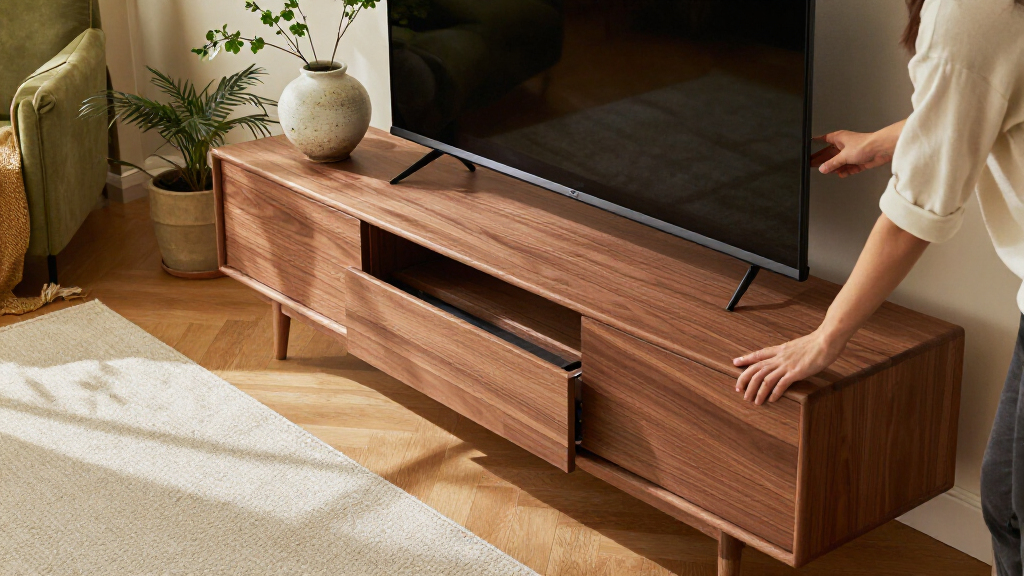
Other examples use furniture already suited to a room: designer John Wooden placed a TV in a mid-century credenza, while designer Lynne Uhalt located one inside a guest-room closet. In a colorful living room, designer Shazalynn Cavin-Winfrey put the screen in a cabinet and covered its glass with fabric selected to echo the room’s colors.
Some approaches leave the television visible but make it fit the visual scheme. The report describes screens matched to nearby frames or decor, dark walls used to camouflage a turned-off screen, and televisions styled to resemble photographs or abstract art. Other featured solutions include a hidden screen in a pagoda-shaped cabinet and a pop-up mechanism. The report’s examples are drawn from individual projects; it does not rank the options or establish that any one method works for every room.
Ways to Reduce Screen Dominance
The roundup addresses a common design tension: televisions are useful in shared rooms, but their dark screens and prominent placement can draw attention when they are not in use. Hiding a screen can help a room serve different purposes, such as shifting from movie viewing to entertaining or quiet conversation, without requiring the television to define the space.
The examples also show that concealment is not limited to expensive custom construction. A cabinet, closet or credenza may provide a simpler route, while built-in doors, moving artwork or pop-up hardware can require more planning. The report does not give budgets, installation requirements or product specifications, so readers would need to check those details for their own homes.
Products Worth Considering

Blueair Blue Pure 211i Max Air Purifier for Large Rooms

Dyson Supersonic Nural Hair Dryer

Philips Hue Bridge Pro Smart Lighting Hub
As an affiliate, we earn on qualifying purchases.
From Storage to Disguised Artwork
The 27 examples in House Beautiful’s report use several broad approaches. Enclosure puts a screen behind doors or inside furniture; integration uses millwork or a wall treatment to reduce its prominence; and camouflage makes the screen resemble artwork or coordinate with surrounding decor. A fourth approach uses a mechanical feature to move the screen out of sight when it is not needed.
The report includes projects for different settings, among them family rooms, guest rooms, kitchens and outdoor living areas. It also describes designs intended to balance different household preferences—for example, a kitchen television used by children while an adult keeps watch. These are project examples, not independent tests of durability, safety, viewing comfort or cost.
““In the main living room, the TV is discreetly integrated into a wall-hung metal joinery box, with hinged doors that elegantly stack back to reveal the screen when needed.””
— Kylie Buhagiar, designer at Golden
Costs and Installation Details
The report does not disclose project budgets, dimensions, hardware specifications or installation timelines for the featured designs. It also does not assess whether particular cabinets provide sufficient ventilation or whether a given wall, furniture piece or mechanism can support a television safely. Those questions depend on the screen and the installation, and the article does not provide technical guidance.
It is also unclear how broadly the showcased solutions can be adapted to ordinary homes: the examples come from distinct design projects, and the source does not compare their practicality or maintenance needs. Readers considering built-ins, wall-mounted hardware or moving mechanisms should confirm requirements with qualified installers and follow the television and hardware manufacturers’ instructions.
Choosing a Concealment Approach
House Beautiful’s report presents the 27 projects as a set of design options rather than a ranked guide or product recommendation. The next step for homeowners is to decide whether the priority is full concealment, a screen that blends with the room, or furniture that can store it when not in use. Available space, viewing position and how often the TV is used will affect that choice.
Before building or buying a solution, readers will need to verify measurements, access to cables and power, ventilation, and any mounting or cabinet requirements. The source does not announce additional reporting or a follow-up date, so further developments are not specified.
Key Questions
What are some ways designers hide televisions?
The examples include cabinet doors, millwork panels, closets, credenzas, fabric-covered cabinet glass, artwork-style panels and pop-up mechanisms.
Yes. The report describes screens coordinated with nearby decor, placed against dark walls, or styled to resemble photographs or abstract art. These approaches make a TV less prominent but may leave it visible.
Does the report say which option costs the least?
No. It includes a designer’s description of a simple millwork system as cost-effective, but provides no prices or comparison across the 27 projects.
Check the screen’s dimensions, ventilation and cable access, as well as the capacity and installation requirements of cabinets, mounts or moving hardware. The report does not give technical instructions for these checks.
Source: housebeautiful.com