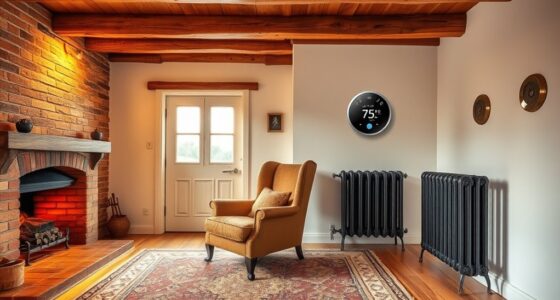
In the early 2000s, luxury KNX homes offered you centralized control over lighting, climate, security, and entertainment, blending convenience with sophistication. You could automate lighting based on time or activity, save energy, and manage multiple systems seamlessly. However, setting up these systems often needed experts, and user interfaces weren’t always intuitive. Scalability was limited, making growth costly and complex. Want to discover how these systems evolved and their true potential? Keep exploring the details.
Key Takeaways
- Early KNX homes integrated centralized control of lighting, climate, security, and entertainment for enhanced luxury living.
- They featured automated lighting and energy management to improve convenience and efficiency.
- Setup and programming required specialized professionals, limiting accessibility and ease of use.
- Compatibility issues and fragmented interfaces reduced user experience and scalability.
- Systems lacked advanced learning algorithms and seamless mobile integration, restricting adaptability and growth.

Have you ever wondered what it’s like to live in a home that seamlessly combines luxury with cutting-edge technology? In the early 2000s, luxury KNX homes brought this vision closer to reality. KNX, a standardized protocol for home automation, allowed homeowners to control various systems—lighting, climate, security, and entertainment—from a centralized interface. It was a game-changer, transforming the way you interact with your living space. With KNX, your home could automatically adjust lighting based on time of day, turn off unused appliances, and even optimize energy management to reduce costs. This level of integration made daily routines more convenient, efficient, and sophisticated, elevating the concept of modern luxury.
However, despite its promise, early KNX implementations had limitations. One of the main challenges was complexity. Setting up and programming the system required specialized knowledge, often involving custom configurations that could be be time-consuming and costly. Homeowners had to rely on skilled installers, which limited accessibility. Additionally, integration wasn’t always seamless. While KNX aimed to unify multiple devices and brands, compatibility issues occasionally arose, meaning that some components wouldn’t work harmoniously out of the box. This sometimes resulted in a fragmented experience where control panels or apps didn’t always communicate perfectly, frustrating users who expected a smooth, intuitive interface.
Another significant limitation was the system’s scalability. While KNX homes could start with basic automation, expanding the network became more complicated as more devices were added. This often involved reprogramming or physically rewiring parts of the home, which could be disruptive and expensive. Furthermore, the interfaces available at the time were somewhat limited, often relying on wall-mounted panels that lacked the flexibility and user-friendliness of modern smartphones or apps. This meant that controlling your home wasn’t always as effortless as it should have been, especially for those used to the convenience of mobile devices. Additionally, early KNX systems lacked the advanced learning algorithms that could adapt to user habits and optimize automation over time, limiting their ability to become truly intuitive.
Energy management was a core feature, and early KNX homes did make strides in helping homeowners reduce energy consumption. Automated lighting and climate control could be scheduled or triggered by sensors, making homes more efficient. Still, the technology lacked the advanced analytics or real-time feedback that would come later, so optimizing energy use was often a manual or semi-automated process. Despite these limitations, early KNX homes laid the groundwork for the sophisticated, integrated smart homes we see today, blending luxury with technology but not without its share of growing pains.
Frequently Asked Questions
How Secure Were Early KNX Home Automation Systems?
Early KNX home automation systems weren’t very secure; they relied on early encryption methods, which had vulnerabilities. If someone gained physical access to the system, they could potentially tamper with or control it. You should be aware that these systems lacked advanced security features, making them more susceptible to hacking or unauthorized access. Protect your system by restricting physical access and updating security measures whenever possible.
What Was the Cost Range for Installing Luxury KNX Systems?
Imagine building a custom yacht—cost estimation for luxury KNX systems in the early 2000s ranged from $50,000 to over $200,000, depending on complexity. You face installation challenges like integrating diverse subsystems and ensuring seamless communication. These projects required skilled technicians and bespoke solutions, making the overall cost highly variable. You’d need to plan carefully, balancing desired features against your budget, much like designing your own high-end vessel.
Were There Compatibility Issues With Other Home Automation Protocols?
You might have faced some compatibility issues with other home automation protocols, as protocol interoperability wasn’t always seamless in early 2000s luxury KNX systems. Components often struggled with integration, requiring additional adapters or custom solutions. While KNX aimed for standardization, varying device protocols sometimes limited smooth communication, making it challenging to achieve full component compatibility and a unified smart home experience during that period.
How User-Friendly Were Early KNX Control Interfaces?
You might find early KNX control interfaces like a double-edged sword; they weren’t the easiest to navigate. The user interface often felt clunky, making the user experience frustrating for homeowners. While some systems offered graphical displays, many relied on simple keypads or dim screens, which could feel like learning a new language. Overall, it was a case of “don’t judge a book by its cover”—initially, it was tricky, but improvements came with time.
Did Early KNX Systems Support Integration With Smart Security Features?
Early KNX systems had limited support for integrating smart security features, so you might have faced security vulnerabilities and difficulties with remote access. While some systems allowed basic security functions, they often lacked advanced protection, leaving your home exposed. You needed to be cautious about remote access because insufficient security could put your system at risk, especially when connecting through the internet.
Conclusion
Imagine stepping into a home where every function seems seamless, yet beneath the surface, limitations quietly shape your experience. The early 2000s luxury KNX homes offered a glimpse of the future—luxury intertwined with technology—but what innovations might have been just out of reach? As you envision these spaces, you wonder: how much more could this technology have evolved? The story isn’t over; the next chapter promises even greater possibilities waiting to be unlatched.